
Tokyo Station Transfers: Shinjuku, Shibuya, Tokyo and Ikebukuro
Use official maps to find gates and lines at Tokyo's major stations. Check Shinjuku's Oedo stations, Keiyo transfers, Shinkansen IC tickets, and elevator routes.
tokyo.how uses affiliate links. If you buy through these links, we may earn a commission at no extra cost to you.
On this page
Choose Your Next Line Before Leaving the Gates
At Tokyo’s large stations, check the railway operator, line, and direction together, rather than the station name alone. Even when looking for the Oedo Line at Shinjuku, the route differs depending on whether your search result says Shinjuku E27 or Shinjuku-nishiguchi E01.
Before setting out, save the route search for your whole journey and the official map of each transfer station. If your map app’s location drifts underground, find a nearby gate name or exit number on the station map.
| Station | What to check first | Official station maps |
|---|---|---|
| Shinjuku | The Oedo Line station name; Keio Line versus Keio New Line | JR Shinjuku, Toei Shinjuku E27/S01, Shinjuku-nishiguchi E01 |
| Shibuya | Ginza Line above ground; Hanzomon and Fukutoshin lines underground | Tokyo Metro Shibuya, JR Shibuya |
| Tokyo | Your Shinkansen line; Marunouchi side or Yaesu side | JR Tokyo, Tokaido/Sanyo Shinkansen |
| Ikebukuro | Marunouchi, Yurakucho, or Fukutoshin Line | Tokyo Metro Ikebukuro, JR Ikebukuro |
Five Steps for a Platform-to-Platform Transfer
- Before leaving your train, check the next line and direction in your route search.
- On the platform, look for signs to that line. Distinguish “Exit” signs leading outside from “Transfer” signs leading to another line.
- Check the gate and floor on the station map. With large luggage or a stroller, choose a route that connects the elevator symbols.
- Before passing through a gate, check whether your ticket or IC card covers the next section. Shinkansen travel requires the booking or ticket arrangements described below.
- On the next platform, check the departure board’s destination and stopping stations. An express train may not stop at your destination even when it runs on the right line.
Until you are familiar with the journey, one planning approach is to add about 10 minutes to the transfer time in your search result. This is this article’s preparation guideline, not an official transfer time for each station. On days with a reserved-seat train or elevator travel, also allow separate time for ticket collection and queues.
Shinjuku: Distinguish the Oedo Line Stations
Start by separating Shinjuku E27 from Shinjuku-nishiguchi E01. Both are Oedo Line stations, but they are not different exits serving the same platforms. Toei’s Shinjuku guide lists E27 and Toei Shinjuku Line S01 together, while Shinjuku-nishiguchi is E01.
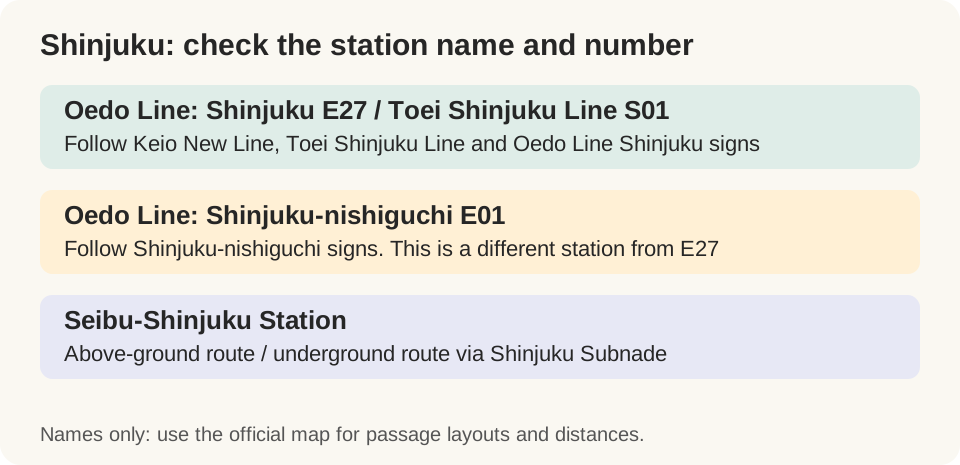
This diagram distinguishes station names. It does not show passage shapes or distances.
From JR to Oedo E27 and Toei Shinjuku S01
JR East’s directions describe routes from the South Gate and West Gate.
| Starting point | Signs and landmarks to follow | Destination |
|---|---|---|
| Outside JR South Gate, 2F | Turn right, pass the Odakyu gates, and follow “Keio New Line Passage” signs downstairs | Gates for the Keio New Line, Toei Shinjuku Line, and Oedo Line’s Shinjuku Station |
| Outside JR West Gate, B1F | Follow the Keio Line/Keio New Line Passage, then choose the Keio New Line passage before the Keio Line gates | Gates toward E27/S01 |
The South Gate route has stairs and changes in level. On the West Gate route, “fewer steps” is not the same as “step-free.” If you need to avoid stairs, open JR’s accessible route map and the connecting operator’s station map, then ask staff about the elevator route before leaving the gate.
If you see Odakyu or Keio Line gates on the way to E27/S01, those are not your entrance. Pause and check that the gate displays the line you need.
Seibu-Shinjuku Also Has an Underground Route
Seibu-Shinjuku is in a different location from JR Shinjuku. From the JR East Gate, you can walk above ground or follow the underground route via the Metro Passage → toward B10 → Shinjuku Subnade → signs for the Seibu Shinjuku Line. JR East’s photo directions show the junctions.
The underground route has stairs. With a stroller or wheelchair, the same guide’s accessible above-ground route is an option. From near the JR East Gate, use the Lumine Est elevator to street level, then an elevator inside the Seibu-Shinjuku station building to the gates on 2F. Check on-site signs for elevator opening hours and construction changes.
Shibuya: Check the Platform Level for Each Line
Shibuya’s Ginza Line is on 3F. Heading downstairs because it is a subway will take you the wrong way, so look for Ginza Line G01 signs first. The Hanzomon and Fukutoshin lines are underground, but on different levels. The Tokyo Metro station map shows gates and platforms separately.
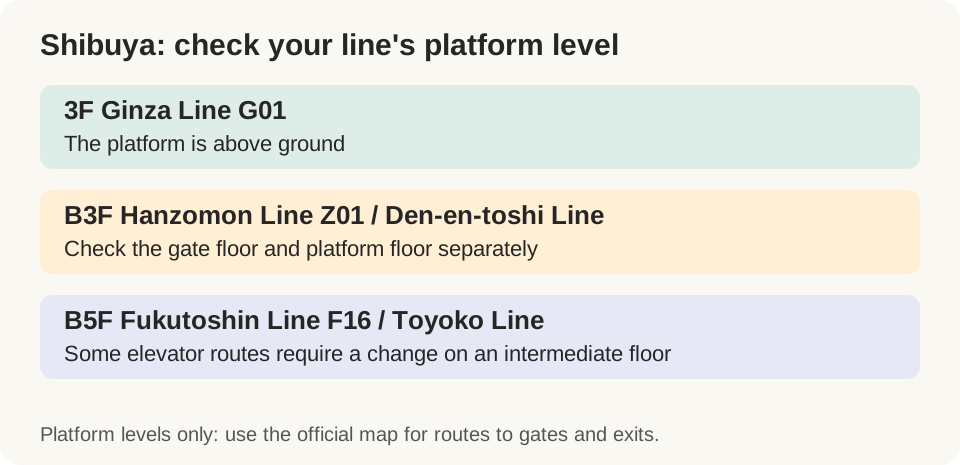
This compares platform levels. A line’s ticket gates are not necessarily all on the same floor as its platforms.
For example, if leaving the Fukutoshin Line with a stroller, an elevator route runs from the platform via the B4F connecting passage to Shibuya Hikarie 1 Gate. Another elevator outside the gate reaches street level, so look for both the platform elevator and the street-level connection. Tokyo Metro’s facilities guide lists locations and planned outages by line.
When transferring from JR, look for the specific symbols G, Z, and F for the Ginza, Hanzomon, and Fukutoshin lines rather than treating them all as one “subway” destination. If temporary construction signs differ from an old screenshot, follow the signs at the station.
The redevelopment plan schedules substantial completion of the station and pedestrian network in fiscal 2030, and Shibuya Scramble Square Phase II in fiscal 2031. Check JR Shibuya’s station map and construction notices for the passages available on your travel date.
Tokyo: Check Your Shinkansen Line and the Walk to Keiyo
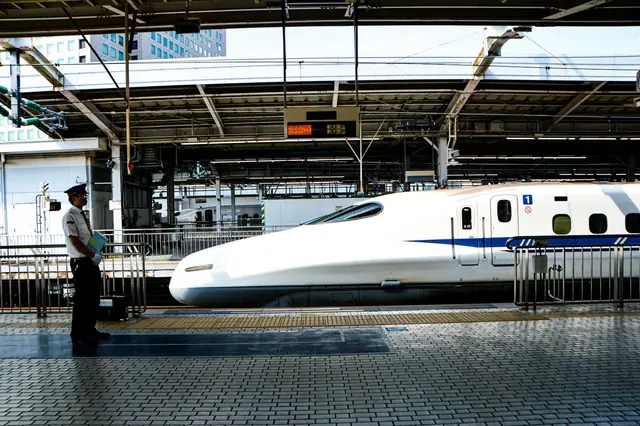
Marunouchi is on Tokyo Station’s west side; Yaesu is on the east. The Marunouchi Line is on the Marunouchi side, while Shinkansen platforms are on the Yaesu side. From JR conventional lines, look for Shinkansen transfer gates inside the paid area. JR Central’s station map shows gates and elevators.
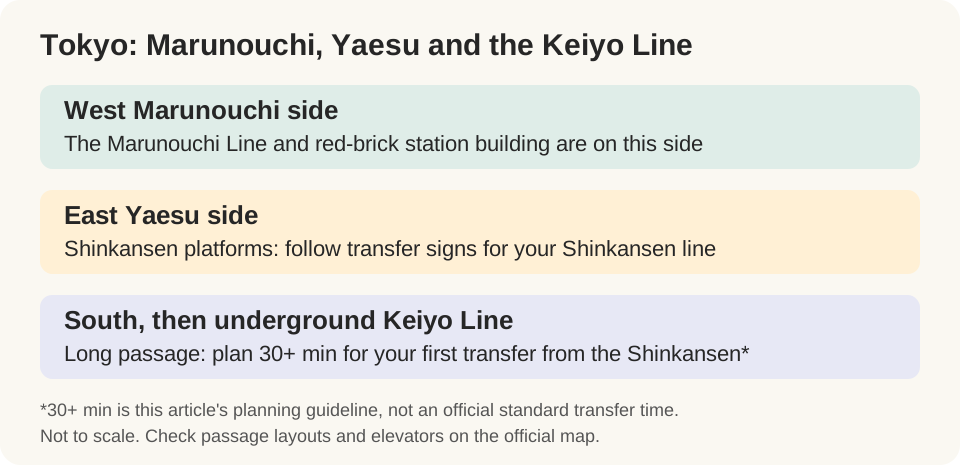
This is a schematic of directions and relative locations. Use the official station map for distances and passage layouts.
The Tokaido/Sanyo Shinkansen toward Kyoto and Shin-Osaka uses different transfer gates from the Tohoku/Hokuriku Shinkansen toward Sendai, Nagano, and other destinations. Check the line and destination on your booking screen as well as the train name before walking to the gates.
Suica Balance and Shinkansen Bookings Are Separate
Even if you arrived on a conventional train using an IC card, you need to prepare for the Shinkansen service you will use. For the Tokaido Shinkansen from Tokyo to Kyoto or Shin-Osaka, have tickets or a booking through a service such as SmartEX.
| Boarding method | What to do before reaching the gate |
|---|---|
| SmartEX IC boarding | Purchase a booking, register your transport IC card, and assign it to the booking. If you also use that IC card on conventional lines, tap it at the transfer gate |
| JR East Shinkansen e-ticket | Link a transport IC card to the booked seat. If using the same card on conventional lines, transfer with that card |
| Touch de Go! Shinkansen | For Ordinary Car non-reserved seats on eligible JR East sections. After initial registration, pay from IC balance without a booking or paper ticket. It does not work on the Tokaido Shinkansen |
| Paper Shinkansen tickets | Have the base-fare and limited-express tickets you collected ready. When combining SmartEX paper tickets with an IC card for conventional trains, insert the tickets first, then tap the IC card |
If the IC card linked to the booking differs from the one used on conventional trains, or you are unsure which section a ticket covers, show both at a staffed gate. See how to use Suica for general IC travel and the Shinkansen booking guide for reservations.
Allow Extra Time for the Keiyo Line
For the Keiyo Line toward Maihama, walk along the long connecting passage to the south of Tokyo Station, then descend to the underground platforms. After leaving a conventional-line platform, stay inside the paid area and follow signs for the Keiyo/Musashino lines. If using elevators, check the route from the passage to the platform in the “Keiyo Line” tab of JR’s map.
JR East’s Keiyo Line transfer guide gives a walk of about 10–15 minutes from conventional lines or the Shinkansen. The guide was updated in November 2024. Walking speed and route affect the time, and the estimate excludes waiting for a train.
For your first Shinkansen-to-Keiyo transfer, this article recommends allowing at least 30 minutes in your itinerary. Crowds and elevator queues may require more. This does not include shopping or ticket collection. If you want to travel with less luggage, luggage storage is another option.
Ikebukuro: Separate Department Store Names from Exit Directions
Ikebukuro’s east and west exits face the usual directions. Seibu Ikebukuro Department Store is on the east, while Tobu Department Store is on the west. The “west” character in Seibu’s name is not a reason to head for the West Exit.
The Marunouchi, Yurakucho, and Fukutoshin subway lines also have separate gates. Open the official station map and find the passage for your next line.
| Connecting line | Gates and location to check |
|---|---|
| Marunouchi Line M25 | Central Passage East and Central Passage West gates (中央通路東改札・中央通路西改札); platforms on B2F |
| Yurakucho Line Y09 | South Passage East and South Passage West gates (南通路東改札・南通路西改札); do not assume they are the Fukutoshin Line gates |
| Fukutoshin Line F09 | West Passage East and West Passage West gates (西通路東改札・西通路西改札) on the west side; platforms on B4F |
For a JR-to-Seibu Ikebukuro Line transfer, use the Seibu station map to choose the ground-level or underground gates. Check the Tobu station map for the Tobu Tojo Line too. A blanket rule such as “south for Seibu, north for Tobu” is less useful than checking the route to the particular gate you need.
One elevator route from the Fukutoshin Line to the west-side street level runs from West Passage East Gate toward Exit C9. There is also an elevator inside the gates from the platforms, so check both locations and planned outages in the line-by-line accessibility guide.
With Luggage, or When You Take a Wrong Turn
With a stroller or large suitcase, choose an elevator route before heading for the nearest stairs. Checking only an elevator marked for street level may still leave steps between the platform and gates. Tokyo Metro’s facilities search distinguishes facilities inside and outside the gates.
| Problem | Next step |
|---|---|
| You accidentally left the paid area | Before tapping in again, go to a staffed gate and show your departure station, destination, and the IC card or ticket you used. Ask staff how to re-enter or settle the fare |
| The passage does not match your map | Move to the side of the passage and check a nearby gate name or exit number. Follow temporary construction signs |
| You cannot find an elevator, or it is out of service | Before leaving the gates, show staff your destination line and ask whether you can get there without stairs. Allow for a detour to another exit |
| You will miss your planned train | Search the whole journey again where you are. Check reserved-seat change conditions and final connections separately; near the end of service, use the last-train guide |
A short note to show station staff is “○○線の○○方面へ行きたいです。エレベーターを使いたいです” (○○-sen no ○○-homen e ikitai desu. Erebeta o tsukaitai desu: “I want to take the ○○ Line toward ○○. I would like to use an elevator”). Include the line name as shown on your booking or route search to reduce confusion between similar station names.
When carrying large luggage during commuting hours, also compare routes with fewer transfers. Metro CrowdNavi shows crowding statistics by line, direction, and time of day.
If steps or the walk from the station to your accommodation are difficult, a taxi is another option. The standard taxi fare for Tokyo’s 23 wards, Musashino, and Mitaka starts at ¥500 for 1 km, then adds ¥100 per 232 m. Allow separately for time charges in traffic, pickup fees, and late-night surcharges, and check an estimate for the full journey when requesting a ride.
Before traveling, save three things: your next line, the gate you need, and the exit nearest your destination. You do not need to memorize the entire station; connecting that day’s route on an official map is enough to prepare.
For days with repeated journeys around the city, the Tokyo transport pass comparison helps you check operators and fares.
FAQ
Are Shinjuku and Shinjuku-nishiguchi the same station?
Do I have to walk above ground to Seibu-Shinjuku?
Is Shibuya's Ginza Line platform underground?
How long does a Shinkansen-to-Keiyo Line transfer take at Tokyo Station?
Can I pass through a Shinkansen transfer gate with just Suica?
Are Ikebukuro's east and west exits reversed?
* This article was translated from the original Japanese with the help of machine translation. Some expressions may not read naturally.
Related Guides
Shinkansen Guide: Booking, Fares & How to Ride
How to book the shinkansen with SmartEX: Tokyo–Shin-Osaka Nozomi reserved fare ¥14,520 in the standard season, seat choices, JR Pass rules, and baggage tips.
Luggage Storage in Tokyo: Compare Prices and Pickup Times
Compare Tokyo luggage storage by price, pickup time and your onward route. See totals for two suitcases at Tokyo Station, locker reservation fees, ecbo cloak and Bounce, late pickup options, hotel storage and airport delivery.
Tokyo's Last Train: How to Check and What to Do If You Miss It
Find the last connection to your hotel and compare taxis, internet cafes, and overnight stays. Check Tokyo taxi fares, venue prices, ID rules, and late check-in.
Tokyo Etiquette — Manners for Trains, Restaurants, Shrines & Onsen
No calls on trains, no swimsuits in onsen, no tipping. A scene-by-scene guide to Tokyo manners for trains, dining, shrines, and hot springs.
Narita & Haneda to Central Tokyo: 2026 Airport Access Guide
Compare trains, buses and taxis from Narita and Haneda to Tokyo with 2026 fares. Find routes to your hotel, late-night options and tips for using Suica.