
Tokyo Stays for Families and Groups of 4–6
Compare two hotel rooms, apartment hotels and holiday rentals in Tokyo for 4–6 people, including beds, children's rates, total costs and late arrivals.
tokyo.how uses affiliate links. If you buy through these links, we may earn a commission at no extra cost to you.
On this page
Breakfast together with bread from a nearby shop, or an evening sharing the day’s photos with friends: a shared room can make time at your accommodation part of the fun on a Tokyo (東京) trip for four to six people. If everyone goes to bed at different times, though, two rooms may be more comfortable.
Start with where everyone will sleep and who will share each room. Find two hotel rooms, an apartment hotel or a rental that meets those needs, then compare the total for the whole stay using the same dates and guest numbers. If you have not chosen an area yet, our guide to six areas to stay in Tokyo can help you narrow it down.
Start with beds and room arrangements
“Sleeps four” and “four people can sleep in separate beds” are different requirements. Children’s ages at the time of the stay, and whether they share a bed, affect both room options and prices.
For a family of four, distinguish age from bed-sharing
For two adults and children aged five and eight who all want their own sleeping space, look for a room with bedding for four. Bed-sharing, sometimes described as “no extra bed,” means sharing an adult’s bedding. It does not provide another bed for the child.
Age categories vary by property. At MIMARU, up to two children aged six or under at check-in do not count toward the room’s capacity, while guests aged seven and over count as adults. At The Gate Hotel Ryogoku (ザ・ゲートホテル両国), up to one child of elementary school age or younger per adult can share a bed for free; children using their own bed pay the adult rate.
Enter each guest in the appropriate age category. MIMARU’s search fields distinguish “Adults: 7 years and over” from “Children: 0–6 years, no bed needed”. For the family above, if the five-year-old shares a bed, enter three in the adult category and one in the child category. If the five-year-old also needs their own sleeping space, ask the property whether bedding is available, whether its cost is included in the total, and which age category to select.
For six adults, count the types of bedding
If six adults want to sleep separately, count single beds, upper and lower bunks, and futons to make sure there are six sleeping places. Some rooms count one double bed as space for two, so capacity alone is not enough. If anyone would struggle with a top bunk or a futon on the floor, decide who would sleep where.
With two hotel rooms, six adults could split into groups of three; a family of four could put one adult and one child in each room. Planning an arrangement that keeps children with an adult if adjacent rooms are unavailable may change which rooms suit you.
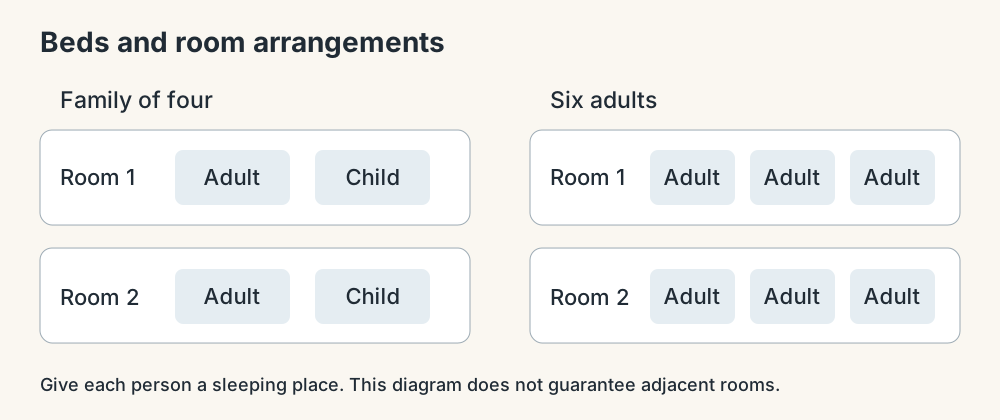
These are examples of how to divide a group between rooms. The diagram does not show an actual floor plan or guarantee adjacent rooms.
Compare two hotel rooms, an apartment hotel and a rental
If you want to eat together, a kitchen and dining table matter. If you want to rest separately, look at how the bedrooms are divided. A property advertised as a house rental may be an apartment within a building rather than a detached house.
| Accommodation | Suits this kind of stay | What to consider |
|---|---|---|
| Two hotel rooms | Family or friends with different sleeping and bathing schedules | With children, plan for an adult in each room |
| One apartment hotel room | Sharing breakfast and conversation around the same table | If an in-room washing machine is essential, filter by the room’s amenities |
| A house or apartment rental | Using a living room and several separate bedrooms | Guest capacity may differ from the number of separate sleeping places |
An example of booking two hotel rooms
The Essential room range at The Gate Hotel Ryogoku includes a 25–26 m² twin for one or two guests and a 26–29 m² Hollywood Triple for one to three guests. Two twin rooms are a possible fit for four guests, and two triples for six. One of the beds in the triple is an extra bed.
Whether two rooms are available on your dates is a separate question. The official FAQ does not guarantee requests such as adjacent rooms. If you need connecting rooms with an internal door, check which room types connect and whether that combination is available.
An apartment hotel example
At MIMARU Tokyo Asakusa Station (MIMARU東京浅草STATION), the 35 m² Family Apartment has two single beds and one bunk bed, providing sleeping places for four adults; the 52 m² One-Bedroom Apartment has four singles and one bunk bed, providing places for six adults. A kitchen and dining area make breakfast bought nearby an option. If a child will use the bunk bed, ask the property about upper-bunk restrictions and look at photos of the guardrails and ladder. If someone cannot use the upper bunk, consider assigning it to an adult.
Neither of these two room types has an in-room washer-dryer; guests use the hotel’s coin laundry. If you want to do laundry in the room while children sleep, for example, choose a property with an in-room washing machine.
An apartment rental example
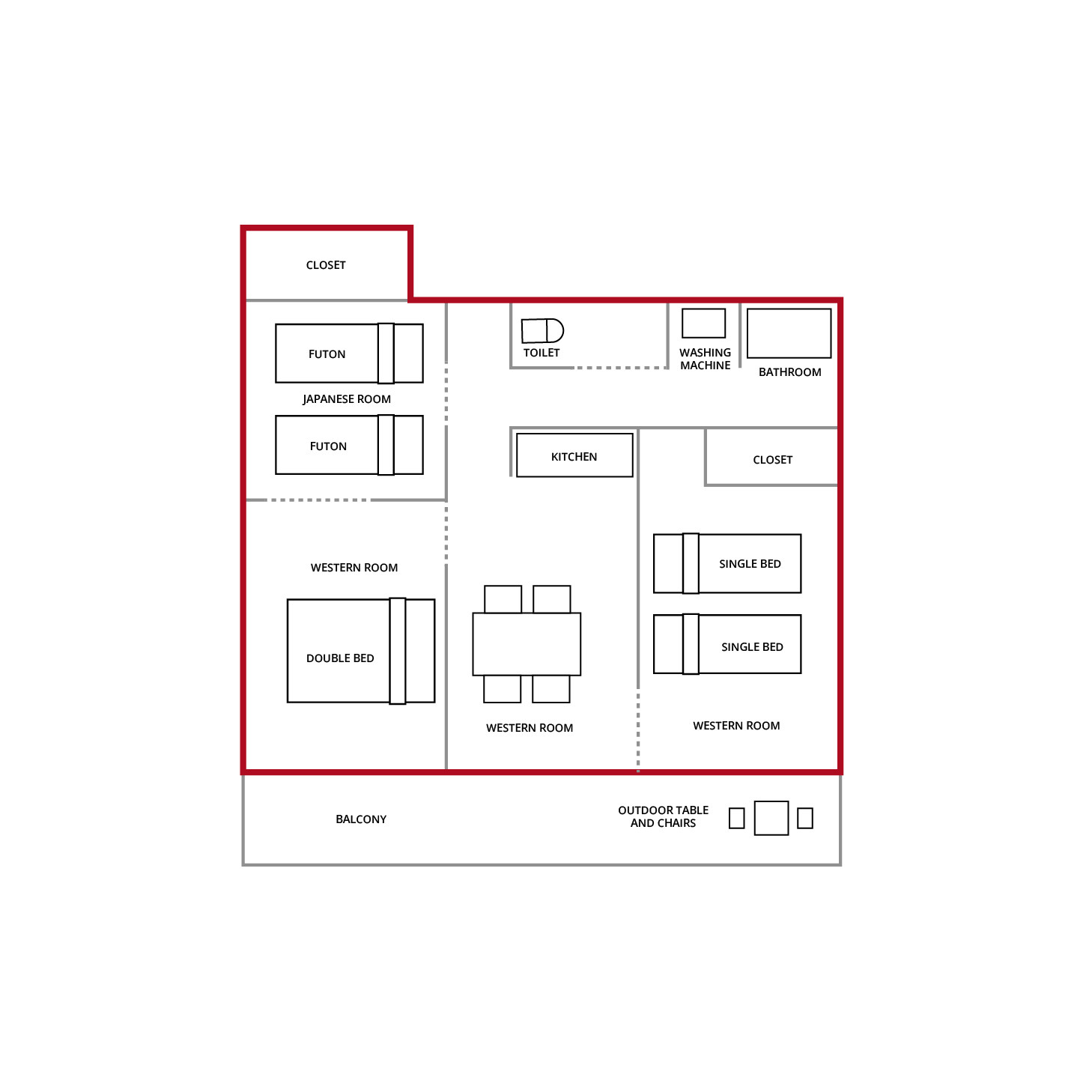
Japan Experience’s Komorebi is a 70 m² apartment in Ikebukuro (池袋), with three bedrooms and space for up to six guests. The amenities list includes a kitchen, washing machine, dryer and elevator. Consider it as an apartment rental rather than an entire detached house.
The official floor plan shows one double bed, two single beds and two futons. That makes five separate sleeping places, so six guests using this arrangement would share the double. If all six want separate sleeping places, ask whether extra bedding can be provided.
Compare the total for everyone and every night
Two hotel rooms and one rental apartment use different pricing units. For the same dates, guests and sleeping arrangements, compare the price of two hotel rooms with one apartment hotel room or one rental unit. Nightly prices may vary during a longer stay, so use the total for the entire stay rather than one night’s rate.
Include cleaning, linen and taxes
If cleaning, linen or accommodation tax is charged separately from the room price, include it in your budget. Do not add a fee again if it is already included in the displayed price.
For example, Japan Experience’s rental FAQ says linen and towel laundry costs ¥1,000 per person, paid separately on arrival. If all six guests use the property’s linen and towels, that comes to ¥6,000. You can also bring your own to avoid this cost. Do not treat this linen charge as a cleaning fee; check the price breakdown for your chosen property.
Meals, member discounts and cancellation terms also affect the price. Comparing a nonrefundable room-only rate directly with a rate that includes breakfast and free cancellation can make it harder to choose the right accommodation for your group.
Payment at the property and cancellation terms
How much you pay at the property, and how you can pay, affects how much cash to prepare before departure. For example, The Gate Hotel Ryogoku accepts payment at check-in by cash, Visa, Mastercard and other methods; some rate plans also offer advance payment. Other properties may not accept the same methods. If anything is payable on arrival, check the payment method in the booking terms too.
If your plans may change, the free-cancellation deadline is another factor in choosing a rate. The rules for reducing a group from six to five people, or cancelling only one of two rooms, depend on the booked rate plan. If a security deposit is required, check how much you need to set aside temporarily on top of the accommodation cost, and the conditions for its return.
Check whether accommodation tax is included
Tokyo’s accommodation tax is separate from consumption tax. Read which taxes a booking page’s “tax included” label covers, and add accommodation tax to the total if it is charged separately.
For late arrivals, check access and key collection
Work out your arrival time at the property by adding immigration, baggage collection and travel from the airport to your flight’s arrival time. Reception hours, the time the building entrance locks, and key-collection hours may differ.
For example, The Gate Hotel Ryogoku locks its entrance from 22:30 to 06:00 and asks guests arriving after 22:30 to contact it in advance. MIMARU also requires advance notice for check-in after 22:00.
Japan Experience’s House Angels page says there is no in-person welcome after 20:00. This does not mean every rental allows late-night self-check-in, so make sure you will receive entry instructions for your specific property. If its arrival rules do not fit your schedule, staying elsewhere for the first night is an option.
For contact details before booking, see the section for guests considering a booking on MIMARU’s official contact page or Japan Experience’s official help center. Sending an inquiry alone does not mean a late arrival has been accepted; check the reply for the agreed arrival time and entry method. For an unexpected delay on the day, use the contact method supplied after booking.
The first person to reach the property should know how to get in and collect the keys, even if someone else made the booking. If a family member living in Tokyo books on your behalf, ask the property about registering guests’ names, checking in when guests arrive separately, and payment under a different name. Share the property’s instructions with the people who will actually stay there.
If you are travelling to the property by train late at night, our guide to checking the last train can help you check connections.
If you will arrive before check-in starts, also check the property’s luggage-storage hours and conditions. If it cannot hold your bags, consider luggage storage at stations and around the city.
Frequently asked questions
Is a holiday rental cheaper than a hotel for six people in Tokyo?
A rental is not necessarily cheaper. Compare the total for the whole stay, including cleaning, linen and taxes, for the same dates, guests and sleeping arrangements. The lowest advertised nightly rate is not enough to decide.
Can two adults and two children stay in one room?
It depends on the children’s ages, the room’s capacity and its bed-sharing rules. If everyone needs a separate place to sleep, choose a room with bedding for four. Free bed-sharing does not mean an extra bed is provided for a child.
Will two hotel rooms be next to each other?
Booking two rooms does not guarantee they will be next door. A request for adjacent rooms is different from a confirmed connecting room arrangement with an internal door. If you have children, plan which adult will stay in each room in case the rooms are apart.
Do apartment hotels have washing machines in the room?
It depends on the property and room type. The Family Apartment and One-Bedroom Apartment at MIMARU Tokyo Asakusa Station have no in-room washer-dryer; guests use the hotel’s coin laundry. Check the amenities for the specific room type.
Can I stay in a holiday rental if my flight arrives at night?
It depends on when you reach the property and how you collect the keys. A self-check-in listing alone does not guarantee late-night entry. Confirm your expected arrival time, entry instructions and contact details for delays. If the arrival rules do not work for you, staying elsewhere for the first night is an option.
Sources and photos
Room details and booking conditions draw on the properties’ room information and FAQs, MIMARU’s FAQ and Japan Experience’s rental FAQ. Accommodation tax information comes from the Tokyo Metropolitan Government Bureau of Taxation page linked above.
Photos: Kiko K and ayumi kubo, under the Unsplash License. They do not show the properties or rooms described here. Diagram by tokyo.how.
* This article was translated from the original Japanese with the help of machine translation. Some expressions may not read naturally.
Related Guides
Where to Stay in Tokyo: Comparing Six Areas
Compare Tokyo Station, Ueno, Asakusa, Shinjuku, Shibuya and Shinagawa around your airport and morning and evening plans. Includes an eight-night cost worksheet, family room checks, station exits and late check-in.
Luggage Storage in Tokyo: Lockers, Apps & Delivery (2026 Prices)
Compare coin lockers (¥300–800), ecbo cloak, Bounce, and luggage delivery from ¥2,000. Station-by-station locker availability tips and what to do when lockers are full.
Tokyo's Last Train: How to Check and What to Do If You Miss It
Find the last connection to your hotel and compare taxis, internet cafes, and overnight stays. Check Tokyo taxi fares, venue prices, ID rules, and late check-in.
Do You Need a Private Guide in Tokyo? Costs and Choices
Compare exploring Tokyo on your own with half-day and full-day private guides, including group prices, extra costs, languages and meeting points.
What to Book in Advance in Tokyo — teamLab, Ghibli & Shibuya Sky (2026)
teamLab, Ghibli Museum, and Shibuya Sky sell out weeks ahead. On-sale dates, prices, booking steps, and free backup spots when tickets are gone.