
Explore
Tokyo Autumn Leaves by Date and Time Available
Compare four Tokyo autumn walks by peak season and time available, with routes, fares from Shinjuku, admission and Rikugien's 2026 evening opening.
On this page
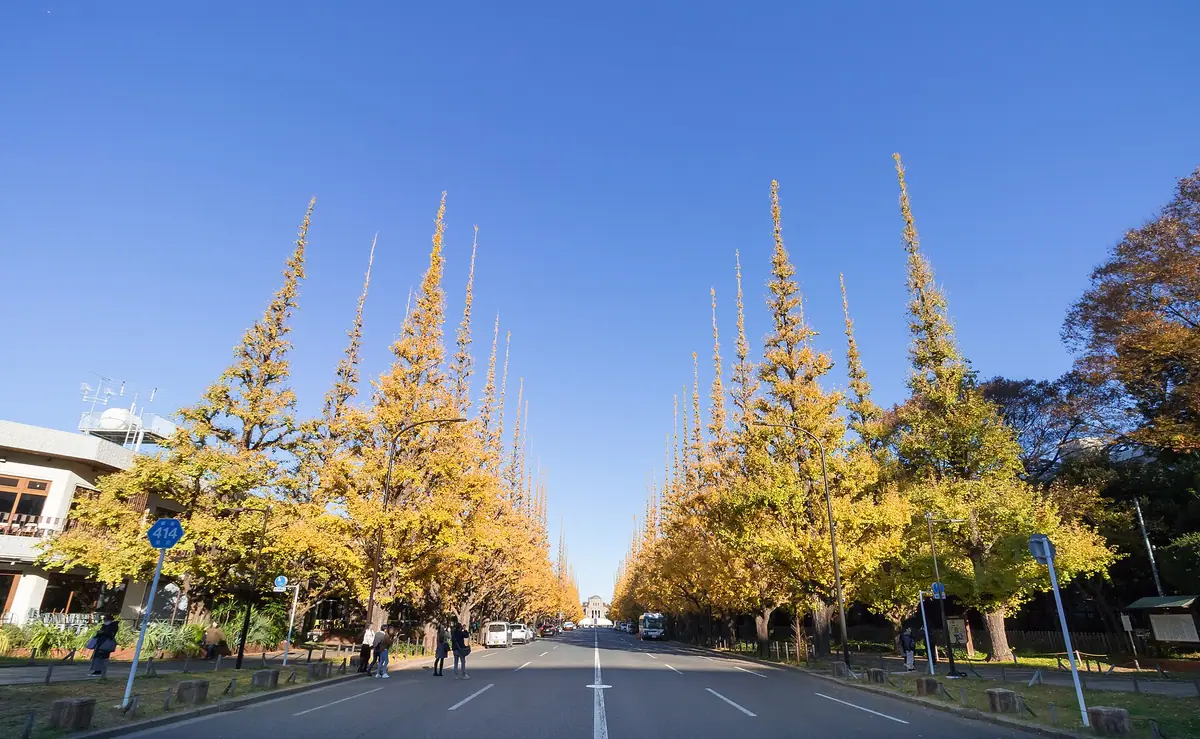
Tokyo’s autumn leaves usually peak in late November to early December if you are visiting the ginkgo trees at Jingu Gaien (神宮外苑) or the maples at Rikugien (六義園). The ginkgo trees at Showa Kinen Park (昭和記念公園) are an option in early November, while Shinjuku Gyoen (新宿御苑) offers maple colors in December.
Jingu Gaien suits a short walk beneath yellow trees, and Shinjuku Gyoen fits between other plans in Shinjuku. Rikugien is a place to linger over a pond and maples; Showa Kinen Park suits a half-day visit combining tree-lined avenues and a garden. Including travel time in your plans makes it easier to choose one place to visit during your stay.
Choose by peak season and walking time
At Shinjuku Gyoen, the usual seasons are November for ginkgo and plane trees, and December for maples. At Showa Kinen Park, ginkgo colors run from late October to late November, and maples from late October to early December. The timing shifts from year to year, so the official updates near the end of this guide can help you compare the current colors before setting out.
| Place | Peak season and trees | From Shinjuku and back |
|---|---|---|
| Jingu Gaien | Ginkgo from late November to early December | 60–90 minutes |
| Shinjuku Gyoen | Yellow leaves in November; maples in December | 90–120 minutes |
| Rikugien | Maples from late November to early December | 2–3 hours |
| Showa Kinen Park | Ginkgo from late October to late November | 4–6 hours |
These are planning estimates for the walking routes below, starting and ending at Shinjuku Station. They include photos, breaks and waiting for trains, but exclude meals and queues to enter during busy periods. If you are choosing your travel month, the guide to when to visit Tokyo may also help.
Fares from Shinjuku and admission costs
The costs below are for one adult visiting during regular daytime hours.
| Place | Admission | Train fare (round trip with an IC card) | Total |
|---|---|---|---|
| Jingu Gaien | Free* | ¥356 | ¥356* |
| Shinjuku Gyoen | ¥500 | ¥0 on foot | ¥500 |
| Rikugien | ¥300 | ¥418 | ¥718 |
| Showa Kinen Park | ¥450 | ¥1,056 | ¥1,506 |
*Free access at Gaien and the total shown are based on information published for 2025. The 2026 admission arrangements have not been confirmed.
Gaien’s fare uses a round trip on the Oedo Line between Shinjuku and Aoyama-itchome, and Rikugien’s uses JR between Shinjuku and Komagome, both paid with an IC card. For Showa Kinen Park, the outbound journey is Shinjuku to Tachikawa and the return is Nishi-Tachikawa to Shinjuku, at ¥528 each. Food, drinks, limited express services, Green Car seats and evening admission cost extra.
Starting from Shinjuku, Shinjuku Gyoen fits a ¥500 budget, while Rikugien is also an option within ¥1,000. If you are staying near another station, replace the train fare with a round trip from your accommodation. The IC card guide covers using trains and topping up your card.
Regular daytime tickets can be bought on arrival at Shinjuku Gyoen, Rikugien and Showa Kinen Park. They accept credit cards and transport IC cards such as Suica. To buy ahead, you can also choose Shinjuku Gyoen’s online tickets or date-specific tickets for Rikugien.
Admission is free for junior high school students and younger children at Shinjuku Gyoen and Showa Kinen Park. At Rikugien, it is free for accompanied elementary school children and younger children, and for junior high school students who live or attend school in Tokyo. Children’s train fares and the conditions for younger children to travel free are set separately by JR and Toei.
Walk the ginkgo avenue at Jingu Gaien and back
The ginkgo avenue stretches about 300 meters from Aoyama-dori, with yellow branches overhead as you walk. An out-and-back stroll along the avenue gives you an autumn walk without a long circuit through a park. Your destination is Meiji Jingu Gaien on the Aoyama side. It is in a different location from Meiji Jingu Shrine on the Harajuku side.
Enter from Aoyama-dori and return the same way
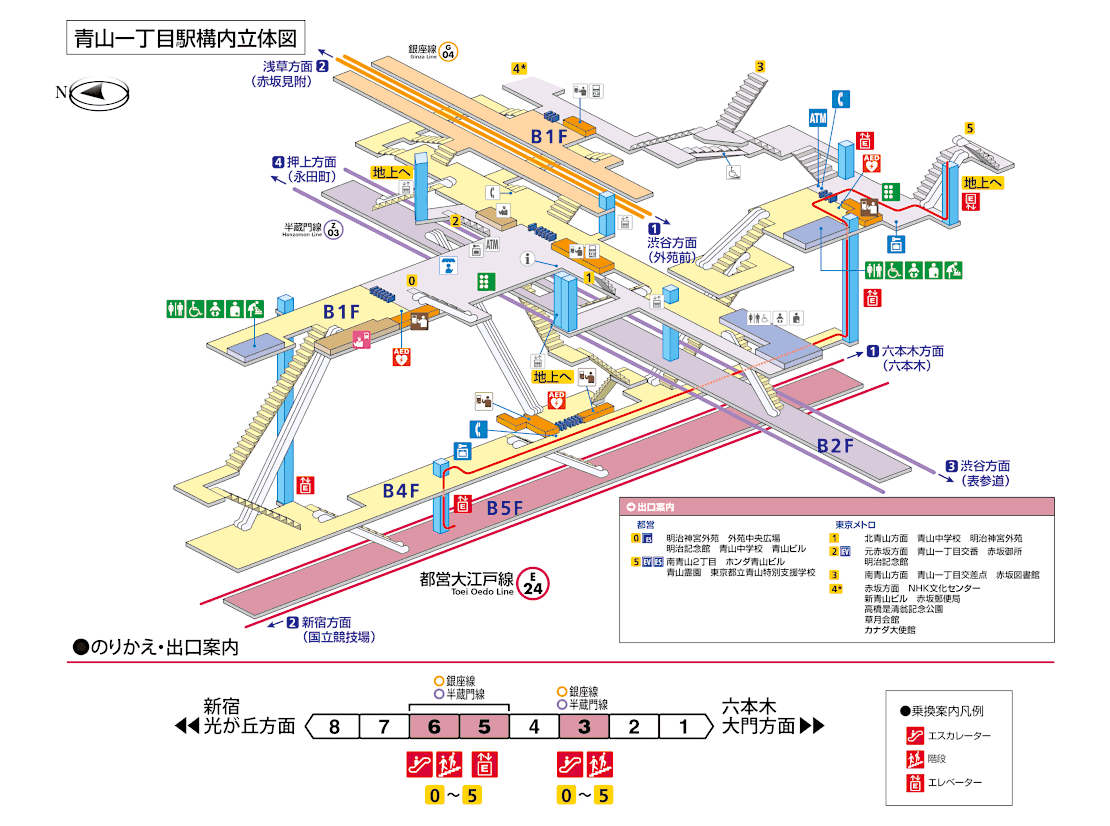
Take the Oedo Line from Shinjuku Station E27 to Aoyama-itchome Station E24. At Aoyama-itchome, follow signs for Exit 0 toward Meiji Jingu Gaien, then head for the avenue’s Aoyama-dori entrance. It is about a five-minute walk from the station to the avenue.
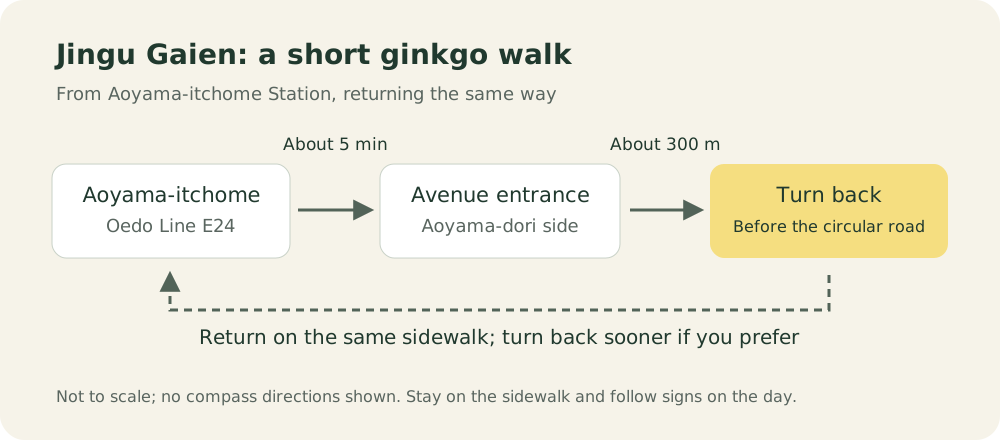
This diagram shows the order of the walk. It does not indicate scale or compass directions.
Following the sidewalk from Aoyama-dori and turning back before the circular road makes the avenue section about 600 meters round trip. Allow 30–45 minutes with photo stops, then return to the station the same way. You can turn back earlier if time is short. Take photos from the sidewalk and follow any directions given on site.
This route does not include a rest facility, so using the station toilets first makes the walk easier. The Meiji Memorial Picture Gallery (聖徳記念絵画館) is scheduled to remain closed through the end of May 2027. For an indoor option on a rainy day, there is the TEPIA Advanced Technology Gallery. Entry is free, with a timed reservation and QR code required. It closes on Mondays, or the following Tuesday when Monday is a public holiday.
See autumn colors beside the ponds at Shinjuku Gyoen
Red and yellow trees surround the ponds in the Japanese Garden, alongside Kyu-Goryo-Tei (旧御凉亭), the Taiwan Pavilion. A walk beside the water with a break at a rest area fits easily before or after shopping or a meal.
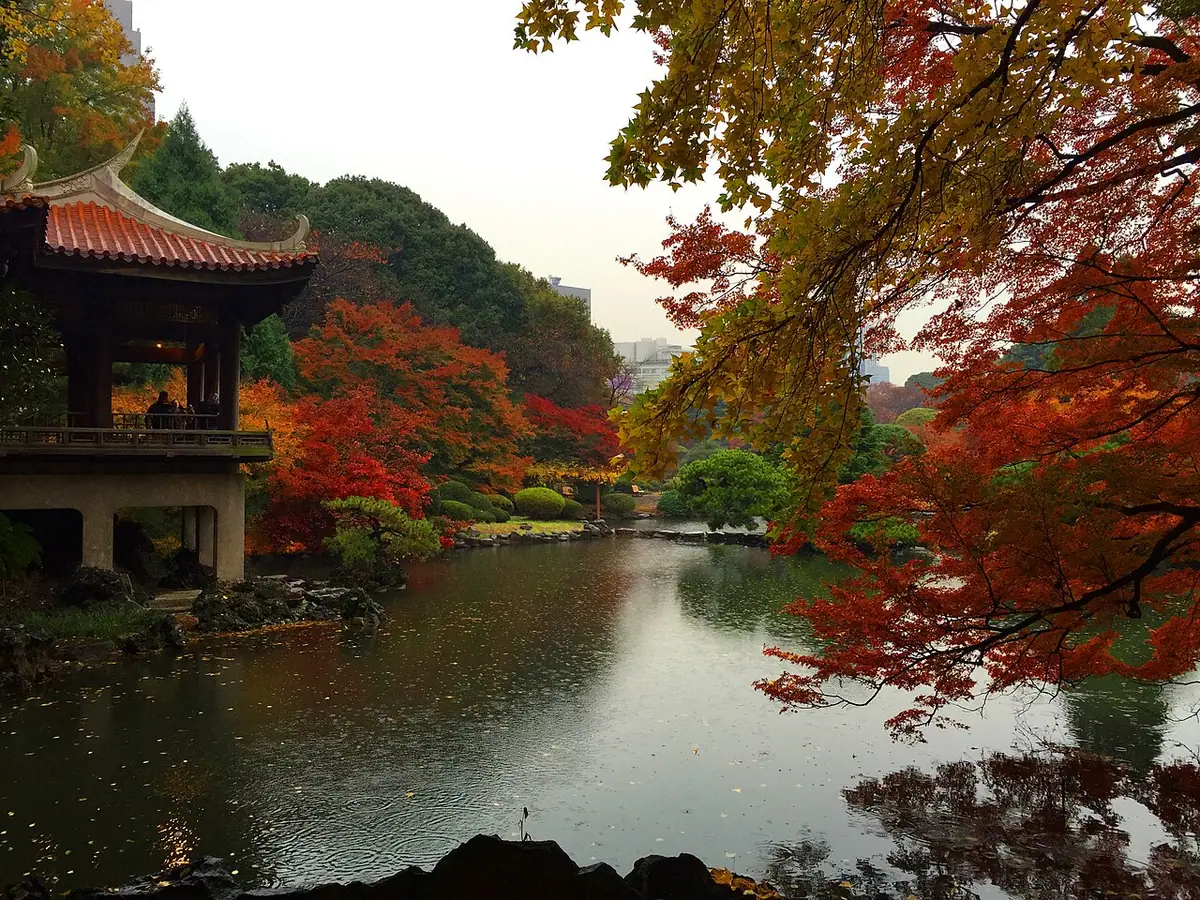
Near Kyu-Goryo-Tei in the Japanese Garden, December 4, 2014. Photo credits
Walk from Shinjuku Gate to the Japanese Garden and back
It is about a ten-minute walk from Shinjuku Station’s South Exit to Shinjuku Gate. Once inside, follow the Japanese Garden ponds to the area around Kyu-Goryo-Tei, then return to Shinjuku Gate via the rest area on the Yurinoki side. Allow 60–90 minutes inside the garden. The Yurinoki and Central Rest Areas offer places to sit at no charge.
For plane trees in November, head to the Formal Garden on the eastern side. Momijiyama (モミジ山) is south of the Lower Pond. If you add either the Formal Garden or Momijiyama to the Japanese Garden walk, allowing 2–3 hours from Shinjuku and back leaves time for breaks. The ¥500 in the comparison table assumes walking both ways and returning through Shinjuku Gate. Leaving through Sendagaya Gate and returning by train adds a fare.
For a route that avoids steps with a stroller, the accessibility map of paths and toilets is useful. There is also an approximately 15-minute route from the station’s Southeast Exit elevator.
Autumn opening hours and afternoon arrival times
From October 1 to March 14, opening hours are 9:00–16:30, with last entry at 16:00. For a 90-minute walk, plan to enter by 15:00 to finish before closing. Reaching the gate a little earlier allows time for a queue.
The closed dates in November 2026 are the 16th, 24th and 30th. During the Chrysanthemum Exhibition from November 1–15, the garden opens on Mondays too. The greenhouse opens 9:30–16:00 in the same autumn and winter period, with last entry at 15:30, so it closes before the garden.
Enjoy Rikugien’s pond and maples with a teahouse break
Rikugien offers views of autumn colors as you walk around the pond. Its usual peak is late November to early December.
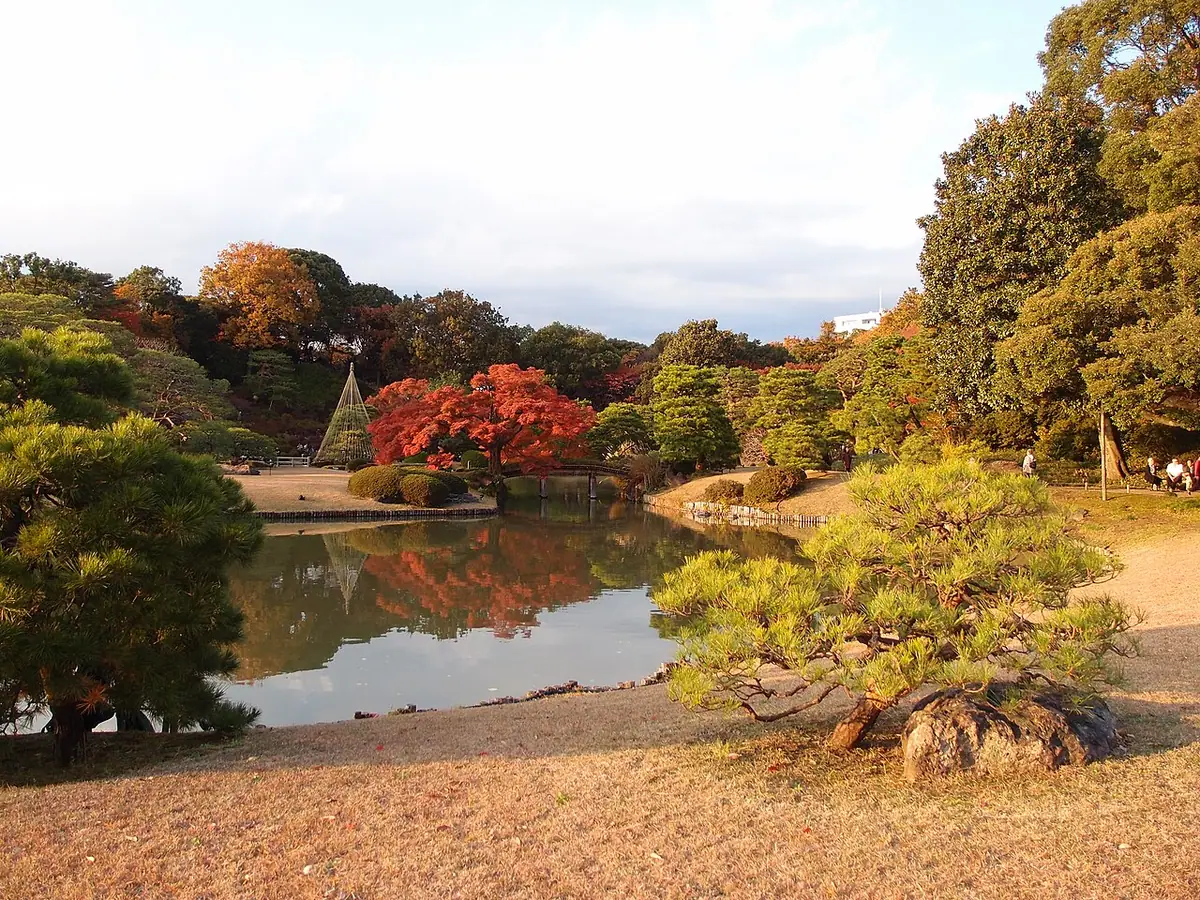
Autumn leaves and Naka-no-shima seen from the shore at Deshio-no-minato, November 26, 2013. Photo credits
Walk from the Main Gate to Fukiage Chaya and back
From JR Shinjuku Station, take the outer-loop Yamanote Line toward Ikebukuro and get off at Komagome Station. The Main Gate is about seven minutes on foot from the South Exit. Somei Gate (染井門), closer to the station, opens only on special occasions. Head to the Main Gate unless an opening has been announced.
Using the garden map, walk from the Main Gate through Naitei-Daimon (内庭大門) to Deshio-no-minato (出汐湊), where the pond comes into view. Follow the pondside path toward Takimi-no-chaya (滝見茶屋) and Chidori-bashi (千鳥橋), continuing to Fukiage Chaya (吹上茶屋). Returning the same way to the Main Gate makes a 60–90-minute walk inside the garden. Fukiage Chaya serves matcha and other refreshments, charged separately from garden admission.
Pond bank repairs are scheduled through November 2026, with a lower water level and some paths closed. You can turn back before any closure. If you also want to visit Tsutsuji-no-chaya (つつじ茶屋) or Fujishiro-toge (藤代峠), the on-site route notices and accessibility map showing steps can help you decide how far to walk.
Aim to enter by 15:30 for a daytime walk
Regular opening hours are 9:00–17:00, with last entry at 16:30. For a 90-minute walk, aim to enter by 15:30. Arriving at the gate with time for any queue makes it easier to fit in a teahouse break.
There is an accessible toilet beside the Main Gate and benches for resting inside the garden. Re-entry is not permitted, so if you leave after entering, you need a new ticket to come back in.
Visit the Canal avenue and Japanese Garden at Showa Kinen Park
Just inside Tachikawa Gate, ginkgo trees line the Canal for about 200 meters. After walking beneath them, you can continue to the maples in the Japanese Garden. This is a half-day outing for seeing both a yellow avenue and garden foliage.
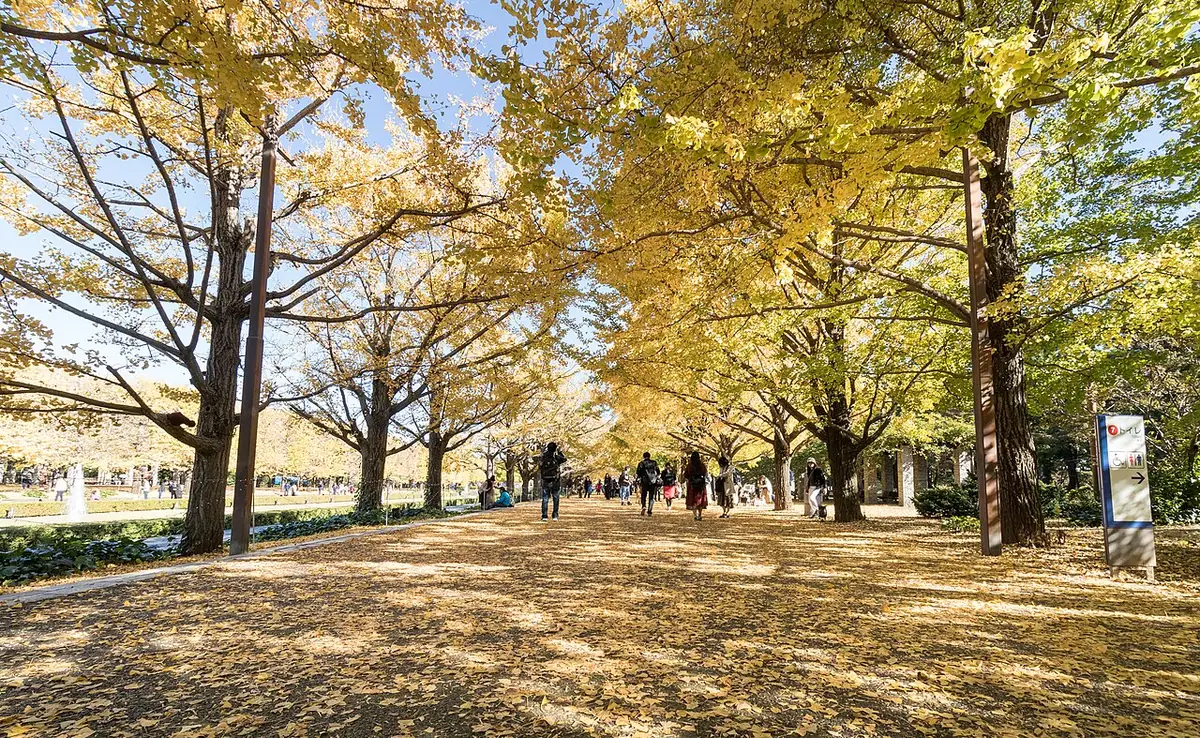
The Canal’s ginkgo avenue, reached from Tachikawa Gate, November 2018. Photo credits
Enter from Tachikawa and leave via Nishi-Tachikawa
From Shinjuku, take the JR Chuo Line toward Tachikawa and get off at Tachikawa Station. It is about an 18-minute walk from the North Exit to Tachikawa Gate, where the paid area begins. Akebono Entrance (あけぼの口), which you pass on the way, leads into the free area; the avenue is farther on. The Canal is about one minute from Tachikawa Gate.
After walking along the Canal’s avenue, follow the park map toward the Japanese Garden. Walk around its pond, then leave through Nishi-Tachikawa Gate. Allow 2–3 hours inside the park for the scenery and breaks, or about 4–6 hours from Shinjuku and back.
To gauge the walking involved, the Japanese Garden is about 25 minutes from Tachikawa Gate and 20 minutes from Nishi-Tachikawa Gate. Allow about 20 minutes to walk from the garden to Nishi-Tachikawa Gate on the way out, then about two minutes to the station’s Park Exit. Take the JR Ome Line to Tachikawa and change to the Chuo Line toward Shinjuku. Trains that continue onto the Chuo Line need no transfer.
If the Canal walk feels like enough, you can return to Tachikawa Gate without continuing to the Japanese Garden. For another ginkgo avenue, Katarai no Icho Namiki (かたらいのイチョウ並木) is about seven minutes from Nishi-Tachikawa Gate.
Aim to enter around 13:00 for an afternoon visit
In November and December, the park opens 9:30–16:30, while the Japanese Garden closes at 16:00. If you plan to spend about three hours inside the park seeing the avenue and garden, entering Tachikawa Gate around 13:00 leaves time to walk to Nishi-Tachikawa afterward.
In the Japanese Garden, you can rest at Seichiken (清池軒), the rest building west of the pond. Toilets are located south of the Canal and west of the Japanese Garden, among other spots shown on the park map. Food outlets close before the park, so for a late lunch, the individual facilities’ opening hours are worth checking too.
The park has announced draining and cleaning of the Japanese Garden pond, along with a leak investigation. Completion of the refill has not been confirmed. If you are hoping to see autumn leaves reflected in the water, checking the pond’s condition before setting out will help you plan.
See Rikugien’s special evening opening in 2026
Alongside illuminated autumn leaves, Rikugien offers video projections onto its storehouse and bamboo grove. The 2026 special evening opening runs November 25–December 6, from 18:00 to 20:30. Last entry is 19:30, through the Main Gate. The garden closes at 17:00, then reopens at 18:00 for visitors with a separate evening ticket.
Advance tickets are online only at ¥1,000; same-day tickets cost ¥1,200. The ticket window accepts cash only, and elementary school children and younger children enter free. Ticket numbers are limited for each date. The official page will announce the sale date and details of how to buy tickets later.
Including the round-trip IC fare from Shinjuku, an evening-only visit costs ¥1,418 with an advance ticket or ¥1,618 with a same-day ticket. Daytime entry adds ¥300. If you visit both in the afternoon and evening, you will spend 17:00–18:00 outside the garden.
Official updates to check before setting out
The dates and locations of this year’s photos can help you picture what you will see on your visit. Each destination’s official pages also gather closure and construction notices.
| Place | Official updates | What else to check |
|---|---|---|
| Jingu Gaien | Operator’s announcements | Autumn visitor information and access restrictions |
| Shinjuku Gyoen | Latest news and seasonal highlights | Closed dates and last entry on your visit day |
| Rikugien | Garden announcements | Paths open during pond bank repairs and evening ticket sales |
| Showa Kinen Park | Seasonal plant updates | Japanese Garden pond conditions and facility closing times |
On a day of heavy rain, indoor places to visit in Tokyo are another option. At Showa Kinen Park, the Hanamidori Cultural Center (花みどり文化センター) is in the free area near Akebono Entrance, on the approach from Tachikawa Station.
Leaving a little space in your schedule before and after an autumn walk lets you stay longer at a place you like. The Tokyo itinerary planning guide can help you fit it into your day.
Frequently asked questions
Can I see autumn leaves in Tokyo in early November?
The ginkgo trees at Showa Kinen Park and plane trees at Shinjuku Gyoen are options. Comparing the current colors at these two places first can help you narrow down where to go in early November.
Is December too late for autumn leaves?
Rikugien’s usual peak extends into early December, and Shinjuku Gyoen has maples and other autumn colors in December. Considering garden maples as well as ginkgo trees gives you more places to choose from.
Where can I go if I have only an hour?
If you are already around Aoyama, Jingu Gaien offers a 30–45-minute walk along the avenue. Allow 60–90 minutes from Shinjuku and back. With only one hour including travel, it fits more easily alongside other plans nearby.
Does a regular admission ticket cover the evening lights?
Rikugien’s 2026 special evening opening requires a separate ticket. A daytime ticket does not cover evening entry. The garden closes at 17:00 before evening admission begins at 18:00.
Photo credits
- Jingu Gaien hero photo: Kakidai, 2019 Jingu Gaien Ginkgo Street in Autumn, photographed in December 2019, CC BY-SA 4.0.
- Shinjuku Gyoen: AllisonMiller, Autumn leaves in Tokyo, photographed on December 4, 2014, CC BY-SA 4.0.
- Rikugien: Guilhem Vellut, Rikugien Garden @ Komagome, photographed on November 26, 2013, CC BY 2.0.
- Showa Kinen Park: Kakidai, 2018 Showa Memorial Park 05, photographed in November 2018, CC BY-SA 4.0.
All photos use reduced-size versions served by Wikimedia Commons.
* This article was translated from the original Japanese with the help of machine translation. Some expressions may not read naturally.





.jpg)
