
Lost and Found in Tokyo: Search, Protect and Report
Lost a wallet, phone or bag in Tokyo? Find the right rail, taxi, airport or police contact, protect your accounts, and check ID, pickup and shipping rules.
tokyo.how uses affiliate links. If you buy through these links, we may earn a commission at no extra cost to you.
On this page
Start with these three actions. Protecting your accounts and looking for the item can happen in parallel, and you can report the loss to the police without waiting for a facility to reply.
- Protect a missing wallet or phone. Go to contacting your card issuer and finding or locking your phone. For belongings that contain neither cards nor a phone, continue to the next action.
- Note where and when you last had it. Use the Japanese inquiry note and contact the company or facility you used. If the location is unknown, write down your route and continue.
- File a lost property report with the police. Use a nearby police station or police box, or the online route if you meet its conditions. This is separate from contacting a facility.
Also check what to do if your ID is missing and collection or shipping when departure is close without waiting for the item to turn up. Tell the police if theft is involved. For a crime or accident needing an immediate response, use the emergency reporting guidance. Official guidance was checked on October 8, 2026; initial actions, card contacts and Tokyo Metro ID examples were rechecked on October 27.
Protect your cards and phone
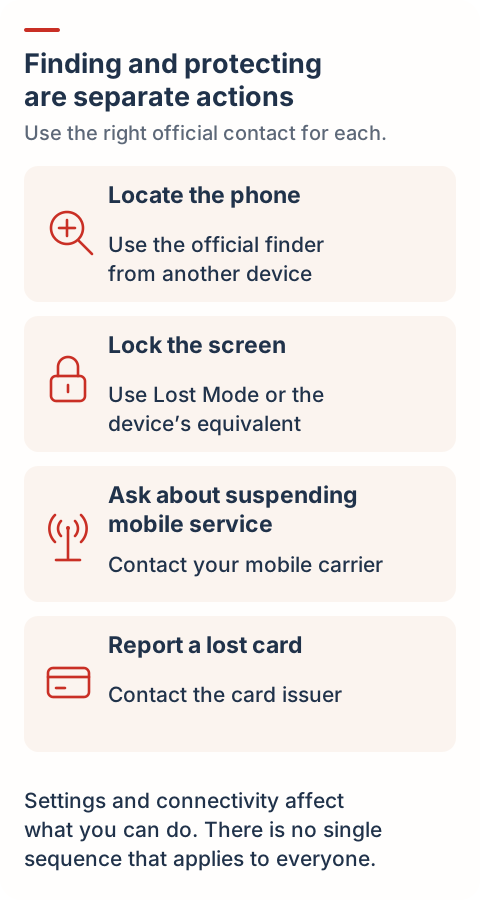
Asking about an item does not also protect it from unauthorized use. Locating a phone, locking its screen, suspending its mobile service and blocking a card involve different services and settings.
Report a lost wallet or card to the issuer
Find the loss-reporting contact on your issuer’s official website or a statement you still have. Visa and Mastercard also direct cardholders to their issuers. You do not need to wait for the wallet to be returned. Reimbursement and emergency replacement cards depend on the issuer’s conditions.
If you have no cash or other card, explain during the same call that you cannot pay for today’s food, accommodation or travel. If you need a Japanese phrase: 「今日の食事・宿泊・移動の支払いに困っています」— Kyō no shokuji, shukuhaku, idō no shiharai ni komatte imasu (“I’m having trouble paying for food, accommodation and travel today”). Ask whether an emergency card or cash can be arranged, what it costs, where and when you can receive it, and which documents you need. Those answers help you adjust the day’s plans.
Transit IC cards have different rules depending on the type. The Suica guide and PASMO guide can help you identify yours.
Find an iPhone or Android from another device
If you can sign in to your account on another device, use the official service to look for your phone. Available actions depend on settings made before the loss, authentication and the phone’s connection.
| Phone | Where to find and protect it | If authentication or settings stop you |
|---|---|---|
| iPhone | Select the device through Find My or iCloud and mark it as lost | If iCloud’s device-finding page asks for a verification code, choose “Find Devices.” The service is unavailable if Find My was disabled before the loss |
| Android | Follow the official Find Hub instructions in an app or browser on another device. A friend’s app also offers guest sign-in | You may be asked for the device PIN or two-step verification. Check your backup authentication options |
On a borrowed device, follow the guidance to use private browsing and close it to sign out when finished.
Even if you cannot sign in, you can still contact the relevant place and report the loss to your card issuer. Android’s Remote Lock using a phone number requires prior activation, an active SIM, a verified number and other conditions. A data-only travel eSIM does not necessarily meet them.
Apple and Google also advise contacting the mobile carrier. Suspending service changes the phone’s connectivity, so ask your carrier how to sequence this with remote actions. Remotely erasing an iPhone cannot be undone, and Find Hub can no longer locate an Android device after a factory reset. Check the effect on further searching before erasing it.
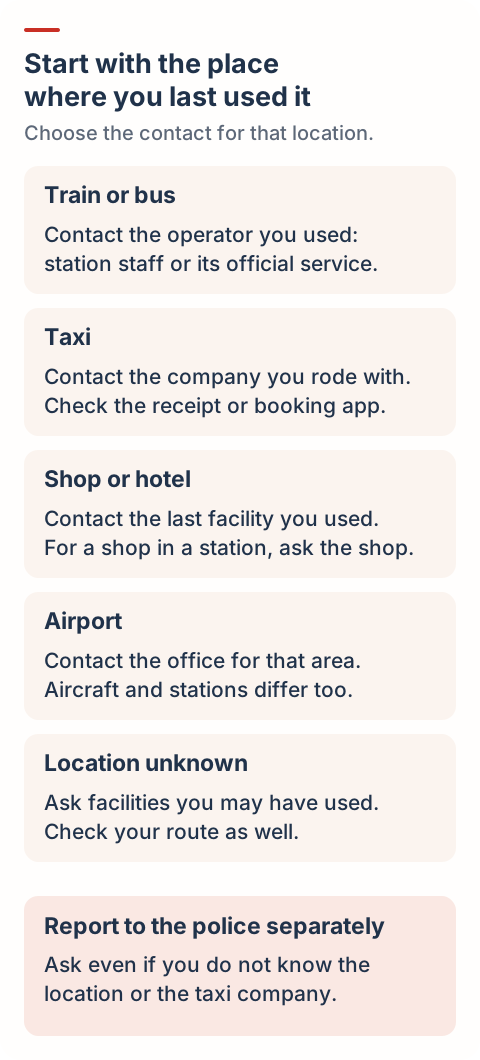
Contact the place where you last used it
Start by noting the item, date, time and last place where you definitely had it in the inquiry note. If no facility comes to mind, write down your route and go to reporting the loss to the police. Add your departure date if you have one.
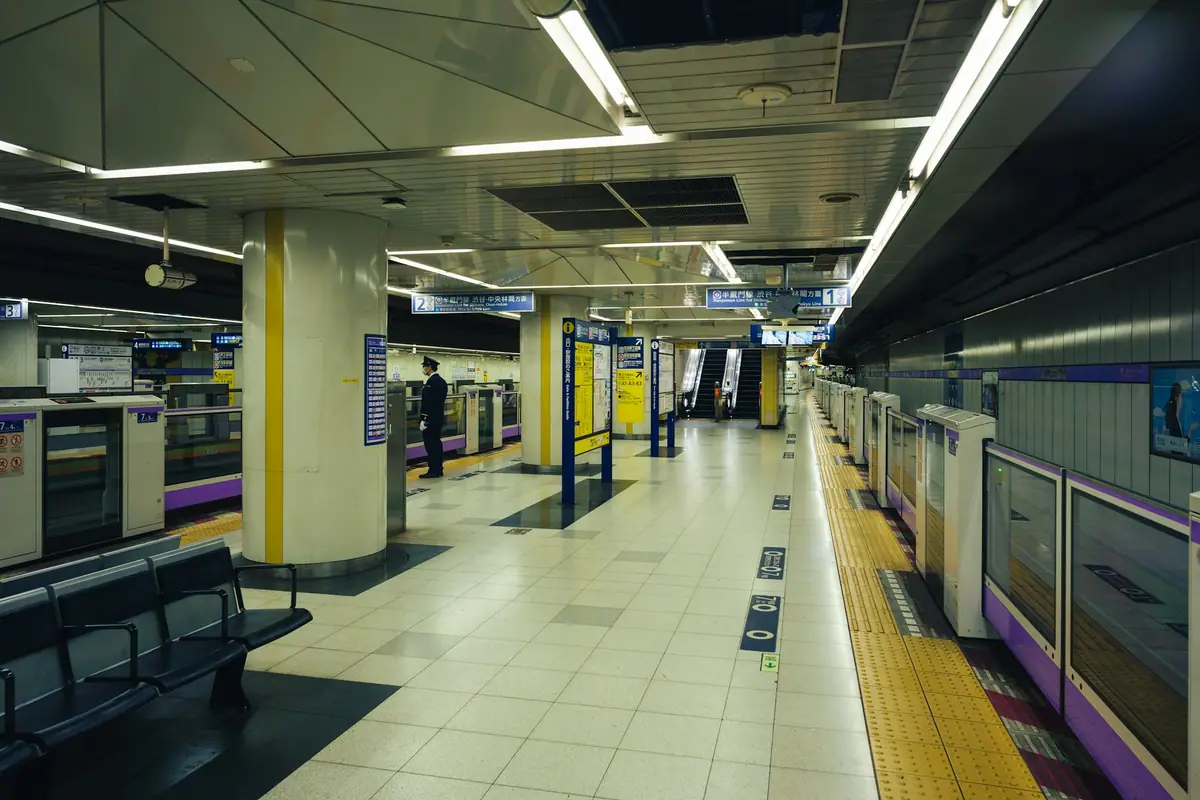
For trains and buses, identify the operator
Give the line, boarding and alighting stations, date, time and direction of travel. The station navigation guide can help you identify the operator or station.
| Operator | First contact and online route | Storage and collection |
|---|---|---|
| JR East | A nearby station or the official chat. Chat submissions: 24 hours; replies: 9:00–21:00 | Storage periods vary by station, after which items go to the police or another designated office. Discuss delivery at a station |
| Tokyo Metro | The station office on the day of the loss; an English form is also available | Normally the Lost and Found Center at Iidabashi (飯田橋) from the following day through day 4, then the Tokyo Metropolitan Police from day 5. Exceptions apply, so confirm the current location |
| Toei Transportation | The station where you got off for the subway, or the depot/branch for buses. Chat submissions: 24 hours; replies: 9:00–22:00 | Items move to collection stations, centers and the police. Weekends and holidays affect the schedule; do not choose a collection point by elapsed days alone |
JR and Toei chats offer Japanese, English, Korean and Simplified Chinese, with email authentication for inquiries. You may need to wait after submitting; Toei answers new inquiries received from 21:00 onward after 9:00 the next day. Round-the-clock submission does not mean round-the-clock replies or collection.
Tokyo Metro’s English form requires a phone number. Acceptance of a number from outside Japan has not been verified. Its English telephone service also states that it cannot be reached from international phone numbers. If you cannot meet the form’s requirements, ask station staff and check how you can stay in contact.
On through-running trains, the item may be found by a connecting operator. Use the relevant company’s official contact for private railways and other operators’ Shinkansen services. If nothing is found immediately, JR advises asking again after some time.
A station platform at sunset. Photo: Fumiaki Hayashi / Unsplash
For taxis, check the receipt or app
The Tokyo Taxi Center’s guidance says to contact the company if you can identify it from a receipt or booking app; otherwise, report the loss at a police station or police box (kōban, 交番). If you remember the roof light, the radio-dispatch company list on that page may help identify the operator. The center itself does not handle lost property. Ask the taxi company about storage periods and shipping.
For shops and hotels, contact the facility you used
If you have a likely location, such as a shop or reception desk, contact that facility through its official channel. The guidance for items left in station shops such as Echika and Esola also directs you to the shop. Being inside a station does not necessarily put an item in the railway’s custody.
Before asking someone else to make contact, check what they can do. If you ask a hotel to call or collect an item for you, confirm the scope of its help.
At Haneda and Narita, give the terminal and area
Choose the relevant facility through the Haneda Airport (羽田空港) lost property guide or Narita Airport (成田空港) lost property guide. Add the flight number, whether you were arriving or departing, and the last area where you used the item to your inquiry note.
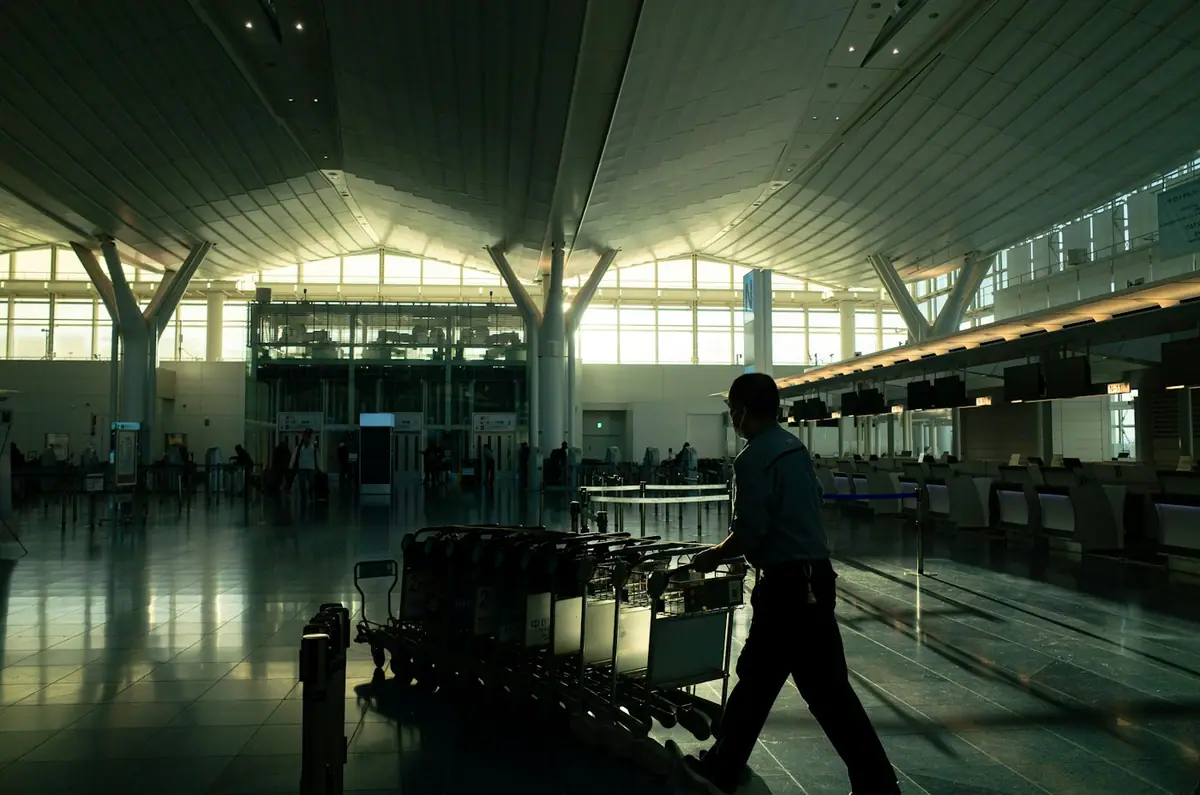
Inside Haneda Airport. Photo: Rica Hanataba / Unsplash
Contact the airline for an item left on board or in an airline-managed area, and the railway for stations or trains. At Narita, the area after international-departure security and the arrivals customs area are also handled by Customs.
At Haneda, the division depends on the terminal. The area from international-departure security to the gates in T2 is handled by the airport, while the equivalent area in T3 and the specified international-arrivals areas are handled by Customs. Give the terminal as well as saying “after security.” Even a chat covering several facilities does not cover every company and area.
Separate police reporting from searching
A facility inquiry, the police lost property search and a lost property report (ishitsu todoke, 遺失届) are separate. Sending an inquiry does not file a police lost property report.
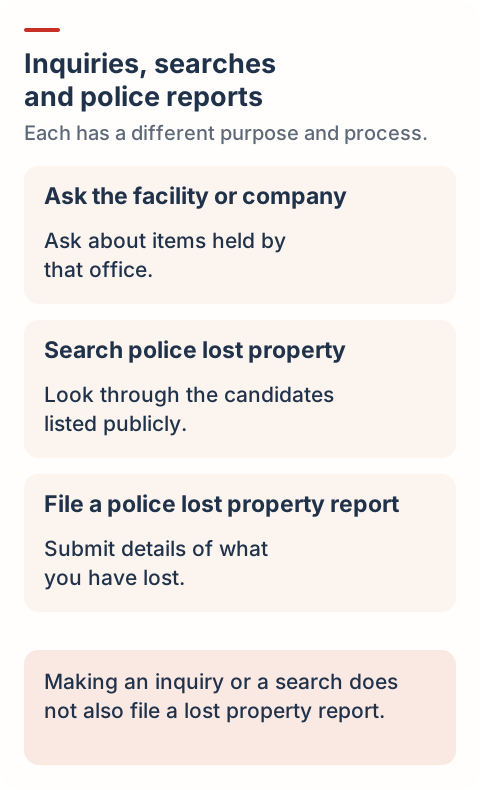
In-person and online reporting conditions
For an item lost within Japan, you can file a lost property report at any police station or police box. Go in person if you want staff to check immediately whether it has been handed in. Online submission is available when the lost property contains less than ¥1 million in cash, but losses at home or outside Japan, among others, are excluded.
You can submit online at any time, but the data is normally received for processing on the next working day. Check eligibility and required fields on that application page.
If you cannot complete the phone field or the Japanese application, use the English lost property report form and instructions or the inquiry note at an in-person counter. Explain how you can receive a reply. Before naming a contact in Japan, obtain that person’s permission and check what they can help with.
Some items do not appear in search results
The Tokyo Metropolitan Police lost property search is in Japanese. Named items whose owners have been identified, mobile phones and some other property may not appear. It also takes time for an item handed to the police to become searchable, so an empty search result is not conclusive.
For a possible match, use the contact shown in the results. If you are in a hurry, the guidance says to contact a nearby police station or the relevant local station. Keep the online submission reference number (seiri bangō, 整理番号), the reference number for the found item (juri bangō, 受理番号), and a separately requested police certificate (keisatsu shōmei, 警察証明) distinct in your records.
Prepare a note for inquiries
These sample phrases can be shown at a counter or copied into an inquiry. They are not an official application form.
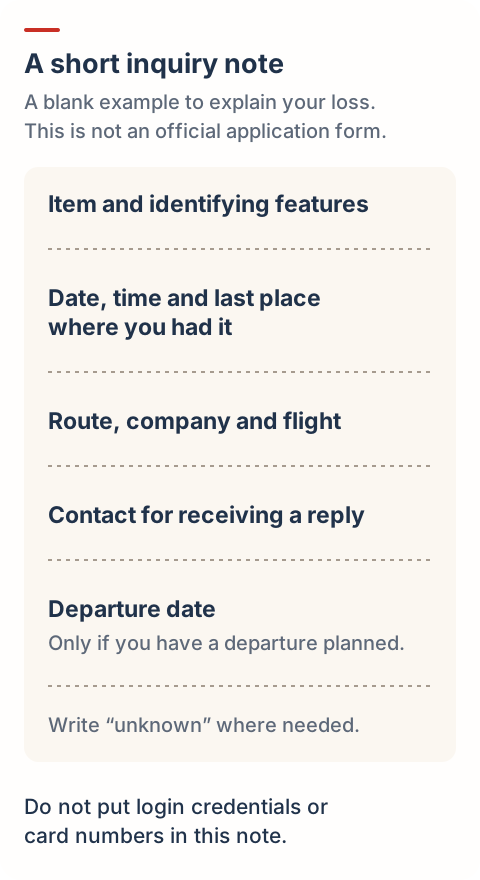
| What to record | Details |
|---|---|
| Item and last location | Color and identifying features; the date, time and place where you definitely last had it. Mark unknown details as “unknown” |
| Route and contact method | Line, direction, boarding/alighting stations or flight number, and how you can receive a reply. Add your departure date if you have one |
| Inquiry record | Who you contacted, the reply, the advised storage location, and any reference number. Note which procedure each number belongs to |
○月○日の○時ごろ、○○で○○をなくしました。色は○○、特徴は○○です。保管場所と受取条件を確認できますか。
[Month]-gatsu [day]-nichi no [time]-ji goro, [place] de [item] o nakushimashita. Iro wa [color], tokuchō wa [features] desu. Hokan basho to uketori jōken o kakunin dekimasu ka.
“I lost [item] at [place] around [time] on [date]. It is [color], with [features]. Could you check where it is held and what I need to collect it?”
If you can use email, you can also add the following. If you cannot, discuss a contact method at the counter.
日本の電話番号がありません。連絡はメールで受け取れます。電話番号なしで問い合わせる方法はありますか。
Nihon no denwa bangō ga arimasen. Renraku wa mēru de uketoremasu. Denwa bangō nashi de toiawaseru hōhō wa arimasu ka.
“I don’t have a Japanese phone number. I can receive replies by email. Is there a way to make an inquiry without a phone number?”
If you have a departure date, add 「○月○日に日本を出ます」— [Month]-gatsu [day]-nichi ni Nihon o demasu (“I leave Japan on [date]”). If your ID is also missing, add 「手元には○○があります。受取には何が必要ですか」— Temoto ni wa [document] ga arimasu. Uketori ni wa nani ga hitsuyō desu ka (“I have [document] with me. What do I need to collect the item?”).
Leave card numbers, phone passcodes, passwords and verification codes out of a shared note. See also the information Apple says not to share. If identification is required, confirm the recipient and submission method through the official office.
Collection, missing ID and leaving Japan
The collection point may differ from where the item was found. Before traveling, confirm the holding office, collection deadline, opening hours and required documents.
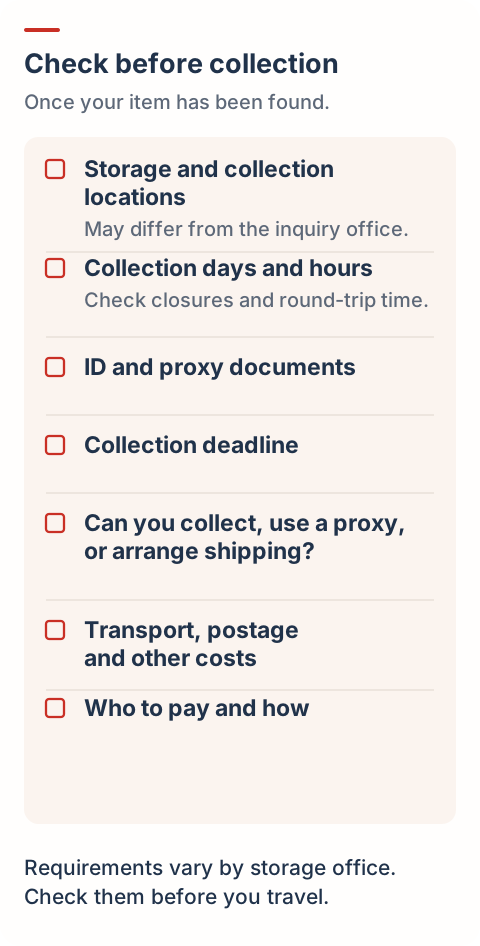
Confirm the location, hours and identification
Police stations and the Lost and Found Center (Ishitsubutsu Sentā, 遺失物センター) allow collection on weekdays from 8:30 to 16:30, excluding weekends, public holidays and December 29–January 3. These hours do not apply to railway offices. JR cannot transfer an item to another station for collection; check collection hours at a nearby JR East station or with its inquiry service.
Tokyo Metro’s Iidabashi office is open from 9:00 to 20:00, but confirm the holding location given in the reply before going there. The Tokyo Metropolitan Police asks owners to collect items within three months of their arrival with the police. Check the actual deadline with the holding office, whether or not you are leaving Japan.
Tokyo Metro divides acceptable identification into documents usable alone and documents requiring two types (PDF). Examples from the list are:
| Tokyo Metro document category | Examples |
|---|---|
| One type is sufficient | Residence card (zairyū kādo, 在留カード), My Number Card |
| Present two types from this category | Passport without an address, employee ID with a photo, student ID with a photo but no address, among others |
One example is a passport without an address together with a photo employee ID. The guidance also says to bring a personal seal (inkan, 印鑑), so speak to the holding office before traveling if you lack the documents or a seal. Check other operators’ and police collection requirements separately.
For collection by someone else, consult the police authorization form and document guidance. JR requires a letter of authorization and the collector’s official identification.
If your passport or residence card is also missing
Tell the holding office which documents you still have. Ask how collection works if your ID is inside the lost item or you only have a photo or copy.
For a missing passport, contact your country’s embassy or consulate and ask whether you need a police certificate. The passport FAQ for in-person reports and current online reporting page give different certificate-collection locations. Ask the office handling your report where to collect it and which documents are missing. Applying for a police certificate online does not mean immediate issuance.
Mid- to long-term residents who lose a residence card must apply for reissuance within 14 days of learning of the loss. If you discover the loss while outside Japan, the deadline is 14 days after your next entry into Japan. Check the required documents, including the statement recording the police report reference number, and the deadline without waiting for the card to turn up. There is no application fee, though preparing photos and other materials is separate. This procedure is not for visitors who do not hold a residence card.
Collection, shipping and costs when departure is close
Give your departure date and first check the round-trip travel time, collection hours and deadline. Collection by someone else may be an option if you have a willing person and the required documents. Tokyo Metropolitan Police shipping requires the prescribed procedure, with postage paid on delivery; its English instructions specify an address in Japan (PDF). Dispatch after the document review may take several days.
JR delivery has restrictions on which items can be sent. Visit a nearby station with your official identification and other required documents to discuss it; you cannot apply by phone or chat. Do not assume railways, airports and Customs share the same shipping rules. Ask the current holding office about the destination and whether the item can reach you before departure.
For ordinary belongings, compare the amounts you have confirmed. A return trip along the same route costs twice the one-way fare. If shipping requires a station visit to apply, add that return fare to the shipping cost.
| Option | Fill in your own costs | Who to check with |
|---|---|---|
| Collect it yourself | Return travel: ¥__; travel and collection: __ minutes | The transport operator’s fare information and the holding office |
| Shipping, if eligible | Postage paid on delivery: ¥__; travel to arrange shipping: ¥__ | The holding office and actual delivery company |
| Buy a replacement | Purchase: ¥__ | The shop you would buy from |
Also check costs for authorization documents and other paperwork, and cases where Customs-held items may be subject to tax. Confirm whom you pay and how; postage paid on delivery does not automatically mean cards are accepted. For cards, passports and residence cards, follow the blocking or replacement requirements as well as considering costs.
If you will continue inquiries after leaving Japan, check the guidance on providing a contact in Japan, such as an acquaintance who can be reached there. The travel SIM and eSIM guide can help with communication, and the airport transport guide covers the journey back to the airport.
Top photo: Red Shuheart / Unsplash
FAQ
Does a railway chat inquiry also file a police lost property report?
Can I look for an item without a Japanese phone number?
If my item is not found immediately, can I keep looking?
Can I collect lost property if both my passport and wallet are missing?
Can an item be sent to a hotel or outside Japan after I leave?
* This article was translated from the original Japanese with the help of machine translation. Some expressions may not read naturally.
Related Guides
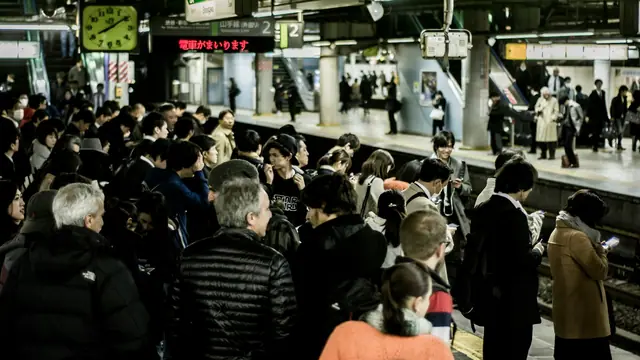
Tokyo Station Transfers: Shinjuku, Shibuya, Tokyo and Ikebukuro
Use official maps to find gates and lines at Tokyo's major stations. Check Shinjuku's Oedo stations, Keiyo transfers, Shinkansen IC tickets, and elevator routes.
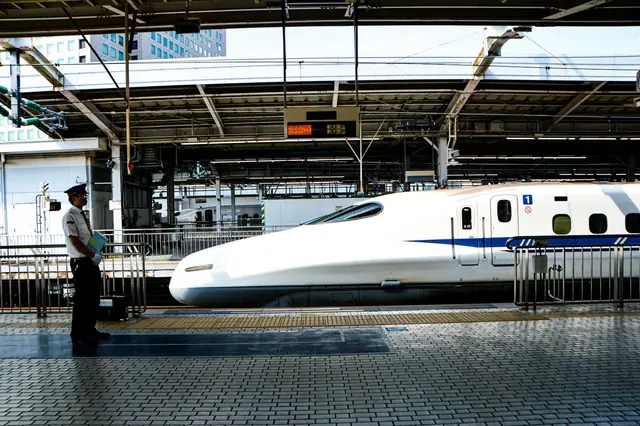
Narita & Haneda to Central Tokyo: 2026 Airport Access Guide
Compare trains, buses and taxis from Narita and Haneda to Tokyo with 2026 fares. Find routes to your hotel, late-night options and tips for using Suica.
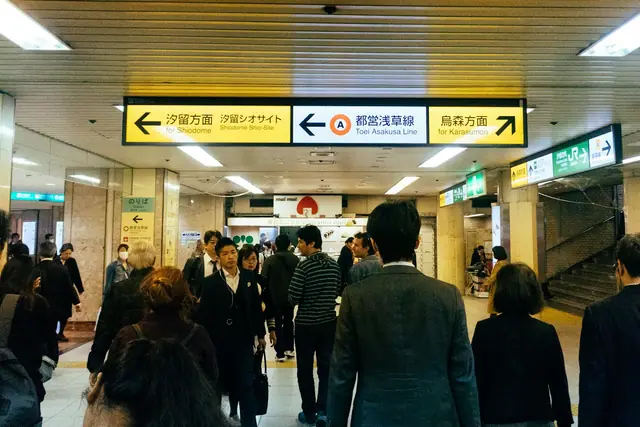
Suica Card in 2026: Buy, Top Up & Use (Physical + Mobile Guide)
Where to buy Suica, child cards, Apple Wallet vs. Welcome Suica Mobile, cash top-ups and refunds: a guide to choosing and using your card.
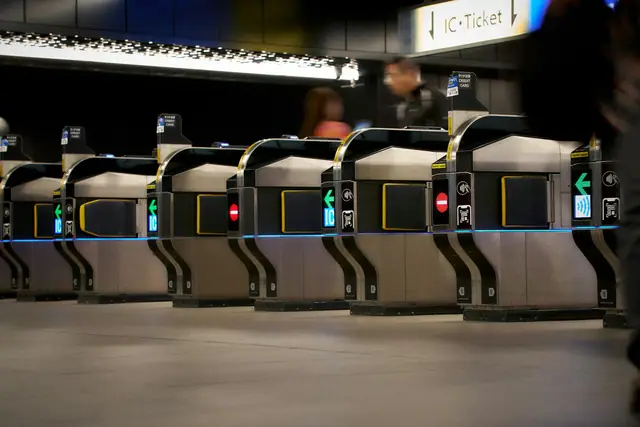
PASMO: Buying, Commuting and Nationwide Use
Compare regular, mobile and TOURIST PASMO. Learn where to buy, top up and get refunds, plus commuter passes and use in Tokyo, Osaka and Kyoto.

Japan eSIM Guide 2026: SIM, eSIM & Pocket WiFi Prices
Compare Japan eSIM, physical SIM and pocket WiFi plans, including Airalo and Japan Experience, with setup steps, airport pickup and key restrictions.