Explore
Magome and Tsumago from Tokyo: Walk the Nakasendo
Walk Magome's stone streets and the Nakasendo to Tsumago on a two-day trip from Tokyo. Plan luggage transfers, 2026 bus fares, and onward travel.
On this page
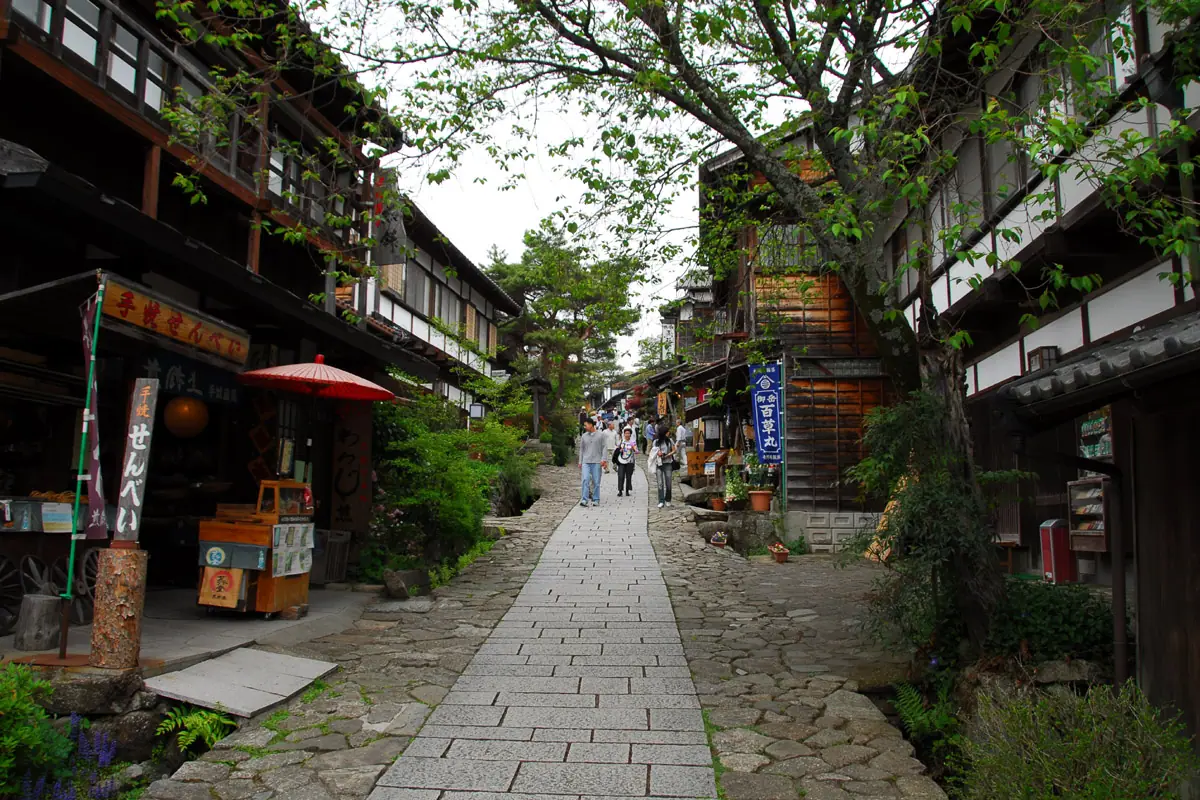
Walk past Magome’s stone-paved slopes and waterwheels, then cross the pass to Tsumago the next morning. Between Tokyo and Kyoto, you can add a day of old post towns and mountain paths. A two-day trip with a night in Magome before the walk lets you enjoy the town and the Nakasendo trail in turn.
The Magome–Tsumago route is 9 km over a mountain pass, with a walking time of 2.5–3 hours. Meals, detours, and children’s breaks take additional time. If that distance suits your usual walking ability, the teahouse and waterfalls along the way are part of the appeal.
Magome-juku is in Nakatsugawa, Gifu Prefecture, while Tsumago-juku is on the Nagano side. Both are in a different area from Takayama. For a wider itinerary including Takayama and Shirakawago, see the Gifu travel guide from Tokyo.
From Magome’s stone streets to a teahouse on the trail
Begin with a walk up Magome’s stone-paved street and a pause by a waterwheel. Explore the post town, stay overnight, and set out on the Nakasendo the next morning. From Magome, a short, steep climb leads to Magome Pass, followed by a long descent toward Tsumago. This is a mountain-pass walk rather than a stroll around town, so wear comfortable walking shoes you have already broken in.
Along the route, Ichikokutochi Tateba Chaya is a free rest stop. You can pause at the teahouse or make a detour to Otaki and Metaki waterfalls. There are places to enjoy before you reach Tsumago itself. Choose a route you can walk comfortably, taking the teahouse’s opening status and conditions underfoot that day into account.
Arrive from Tokyo, then walk to Tsumago the next day
From Tokyo, take the Tokaido Shinkansen to Nagoya, then the Chuo Main Line to Nakatsugawa Station. Change there for a bus to Magome, about 25 minutes away. When searching for trains from Tokyo, use “Nakatsugawa Station” as your initial destination, rather than “Magome Station.”
| Day | How to spend the day | What to check when booking |
|---|---|---|
| Day 1 | Tokyo → Nagoya → Nakatsugawa → Magome. Explore the post town and stay overnight | Bus arrival time, final check-in time, and dinner time at your accommodation |
| Day 2, morning | Drop off your luggage and cross Magome Pass to Tsumago | Luggage drop-off hours and trail conditions that day |
| Day 2, afternoon | Explore Tsumago → Nagiso Station → Nagoya → Tokyo or Kyoto | Connections between the return bus and trains |
Staying the night before lets you send your bags and start the pass walk in the morning. This table is an example itinerary; choose connecting trains and buses for your actual travel date. See the Shinkansen booking guide for Tokyo–Nagoya reservations and Tsumago-juku’s official access guide for trains and buses on the Tsumago side.
After crossing the pass, enjoy a meal and a walk around Tsumago before heading to Nagiso Station. Whether you return to Tokyo or continue to Kyoto, choosing your bus connection and a train that stops at Nagiso in advance helps you avoid rushing the walk. Allow for a longer journey than the official walking estimate when traveling with children or after rain.
It is also possible to arrive from Tokyo on the day of your walk, but the regular luggage service requires drop-off in Magome by 11:30. If you would rather not depend on that morning’s connections, consider staying in Magome or Nakatsugawa the night before.
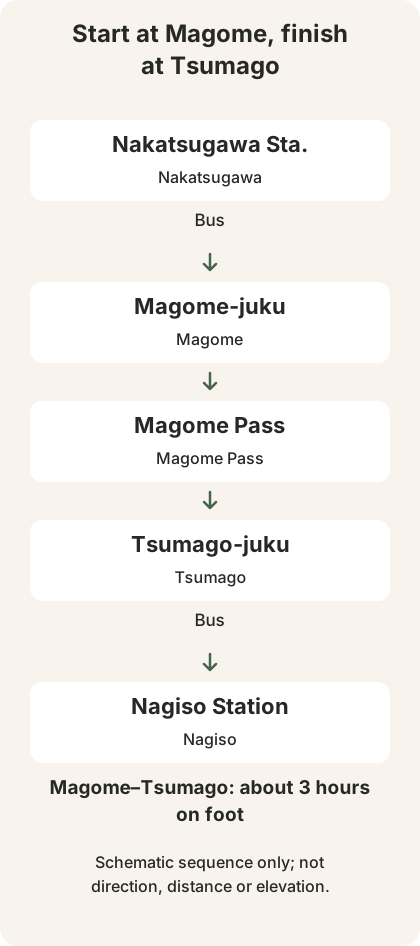
This diagram distinguishes the walking route from transport connections. It does not show compass directions, scale, or elevation changes.
Send large bags ahead and walk with a small one
Sending your suitcase to Tsumago lets you cross the pass with a small bag. The regular luggage transfer service runs from March 20 to November 30, 2026, at ¥1,000 per bag.
Drop off at Magome Tourist Information Center or Magome-juku BASE between 8:30 and 11:30, then collect at Tsumago Tourist Information Center between 13:00 and 17:00. At drop-off, specify “Tsumago kankō annaijo” (Tsumago Tourist Information Center) as the destination. If you are staying in Otsumago, agree on the collection location with your accommodation.
Keep rain gear, drinking water, essential medication, your wallet, and your phone in the bag you carry. Once in Tsumago, collect your luggage by 17:00 before heading for your bus.
If you miss the regular drop-off deadline, a separate on-demand service is listed at ¥4,500 per trip for up to three bags, operating between 8:30 and 17:00. It also applies outside the regular service season. Confirm availability and collection time at the counter before starting your walk.
How much does local transport cost?
If you arrive via Nakatsugawa, walk from Magome to Tsumago, and leave via Nagiso, local buses cost ¥800 + ¥300 = ¥1,100 per adult. Sending one bag brings the total to ¥2,100. This excludes trains to and from Tokyo or Kyoto, accommodation, meals, and building admission fees.
| Route or service | Adult cost | Source |
|---|---|---|
| Nakatsugawa Station → Magome | ¥800 | Official transport guide, April 2026 edition (PDF) |
| Tsumago → Nagiso Station | ¥300 | Nagiso Town fare table |
| Magome → Tsumago luggage transfer | ¥1,000 per bag | Regular 2026 service |
If you take the bus between Magome and Tsumago instead of walking, add ¥1,000 per adult. The official transport guide says IC cards cannot be used, so prepare ¥1,000 notes and coins for bus fares.
Child fares differ by operator. On Kitaena Kotsu’s Nakatsugawa–Magome service, elementary school children pay half the adult fare, and one preschool child travels free per accompanying passenger of elementary school age or older (PDF). On Nagiso Town’s Tsumago Line, elementary school children pay ¥100 and preschool children travel free. For two adults, one elementary school child, and one preschool child, those two bus legs total ¥2,700; sending two bags brings the total to ¥4,700.
For the return, match the “Tsumago” departure with the “Nagiso Station” arrival on Nagiso Town’s Tsumago Line timetable. The April 2026 edition lists 15:40 → 15:48 and 16:10 → 16:18 services (PDF). Other routes also serve these stops, so use the town’s transport information to check the full timetable for your travel date.
Choose a walk that suits the weather and your stamina
If your children are not used to long walks on slopes, you can travel between the two post towns by bus and explore their streets instead. For a shorter hike, the downhill route from Magome Pass to Tsumago is another possibility, though it still involves a sustained descent. Stone paving becomes slippery after rain, so this is not an alternative for bad weather. Before setting out, save the official hiking map and check the day’s trail conditions and return bus times.
If your feet start hurting along the way, stop rather than pushing on, and locate yourself on the saved map. The official Magome Line timetable (PDF) lists stops including Magome-toge, Ichikoku, and Otsumago. You cannot board a bus anywhere along the old trail, however. Check whether you can safely reach a stop and when the next bus leaves. Do not assume a taxi can reach you partway along a mountain path or arrive immediately.
Check bear sighting reports on Tsumago-juku’s official website for current information too. Bear bells can be borrowed and returned at the information centers in both post towns, but a bell does not guarantee safety. In snow or icy conditions, do not rely on the usual three-hour estimate; leave open the option of exploring just the towns.
After the walk, continue to Gero Onsen or Takayama
You could follow the trail walk with a night in Gero’s hot springs or continue to Takayama’s old town. Nohi Bus’s Magome–Tsumago service operates from April 1 to November 30, 2026. It leaves Tsumago at 15:00, reaches Gero Station at 16:50 and Takayama at 18:00, and costs ¥4,000 one way to Gero or ¥5,000 to Takayama.
If you take this bus, finish your Tsumago walk and collect your luggage before 15:00. Advance reservations are required. Follow the “予約する” (Yoyaku suru, “Reserve”) link on Nohi Bus’s route page. Passengers boarding anywhere other than Takayama Nohi Bus Center, including Tsumago, must buy a web ticket at least 10 minutes before departure. Do not assume the same service will run from December 2026 onward. To weigh an onsen stay against easier onward travel to Shirakawago the next day, see choosing where to stay.
A stroll up stone-paved streets, or a walk across the pass linking two post towns: choosing the walk you enjoy is part of this trip’s appeal. Between Tokyo and Kyoto, make a day for walking and stopping along the old road.
Photo: SElefant / Wikimedia Commons, CC BY-SA 3.0. Taken in 2008; image unmodified. Fares and transport information were checked against official sources on September 17, 2026.
FAQ
- How far is the walk from Magome to Tsumago?
- Tsumago-juku's official guide lists a 9 km walk taking 2.5–3 hours. Allow extra time for meals, shopping in the post towns, and breaks.
- Do I need to carry my suitcase along the Nakasendo?
- A regular luggage transfer service operates between Magome and Tsumago from March 20 to November 30, 2026, at ¥1,000 per bag. Drop-off is 8:30–11:30 and collection is 13:00–17:00.
- Are Magome and Tsumago in the same prefecture?
- Magome-juku is in Nakatsugawa, Gifu Prefecture, while Tsumago-juku is in Nagiso, Nagano Prefecture. A walking route across Magome Pass connects them.
* This article was translated from the original Japanese with the help of machine translation. Some expressions may not read naturally.